




The Object of the Month sees the light of day
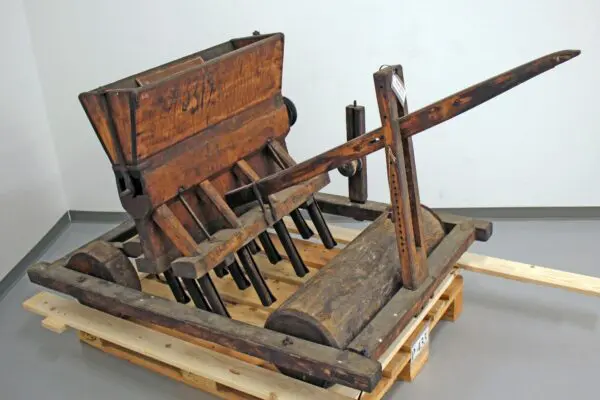
The Lomske row seeder seen from the side.
As something new at The Green Museum, the museum's head of conservation, Esben Bøgh Sørensen, will select an exciting object every month that is not currently part of the exhibitions and talk about it and its interesting history.
You can find these stories on the website under the menu item Knowledge –> Object of the Month.
As the very first object, Esben has chosen a row seeder, more precisely the Loms row seeder, which the museum received in 1902 from the Norwegian agricultural economist and politician Haakon Tveter, on behalf of the 'Royal Society for the Welfare of Norway'.
During the 18th and 19th centuries, attempts were made to construct machines that could gradually sow the seed in even rows and at the right depth. Typically, it was the larger farmers, the nobility and the new agricultural companies that sprang up throughout Europe at that time who took the lead. Among ordinary farmers and servants, attitudes towards the new machines were probably more mixed. There were many traditions and rituals associated with sowing. It was a whole body of knowledge that had been developed over generations. The sower throwing the seed across the field has also been a popular symbol and used as a motif in numerous works of art.
The Lomske seed drill was widespread in parts of Norway. In Denmark, however, sowing by hand remained normal until factory-made seed drills made their appearance in the late 19th century. By 1902, the Norwegian model was already obsolete. During the 20th century, seed drills became increasingly larger and more efficient. However, the large tractor-driven seed drill did not achieve the same iconic status as the sower. Today, farmers are able to sow incredibly precisely with the help of IT technology. The knowledge and expertise required to sow has thus changed significantly over the past 200 years.
You can read more about this month's item here.
About the Green Museum's objects
The Green Museum has around 77,000 objects in our collection, covering the history of agriculture, forestry, hunting and food. Only a small part of our collection is on display at the museum. The rest of the objects are stored so that future generations can also gain an insight into our common cultural heritage.
