




Danish Landrace pig, year 1970
At the beginning of the 18th century, there were two types of pigs in Denmark. On the islands, the pigs were relatively small, densely built and with upright ears – the Ø-svin. In Jutland, the pigs were larger, had an elongated body and large hanging ears – the Jyske Svin.
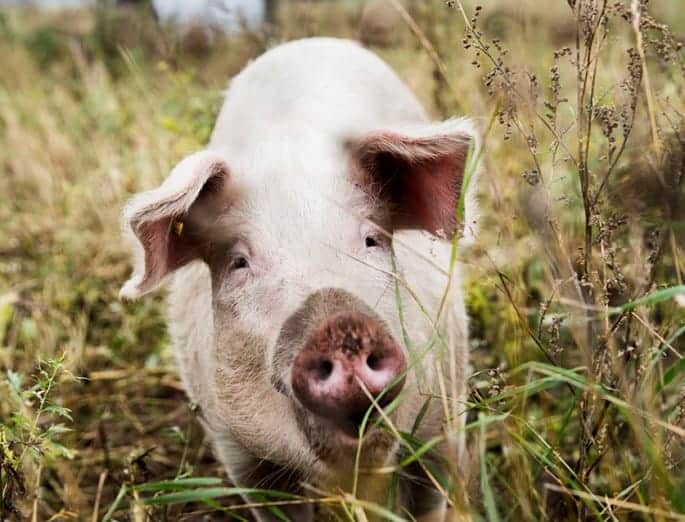
Danish Landrace pigs are mainly descended from the Jutland Pig stock. In 1906, a stud book of Danish Landrace boars began to be kept. Most boars were white, but a few spotted or black-and-white ones were found. During the first half of the 20th century, Danish Landrace was bred specifically for the production of bacon for the British market.
Around 1970, the breeding goals for Danish Landrace pigs were radically changed. Growth, feed conversion, durability, fertility and meat quality were prioritized, and in the 1980s, there was also limited crossbreeding with Norwegian and Finnish Landrace. The type of Danish Landrace now bred at Danish breeding centers is therefore significantly different from the type from 1970.
There is still a population of Landrace pigs of the 1970 type, but the population is very small. As a safeguard, semen and embryos have been collected and stored in liquid nitrogen, including a stock of deep-frozen semen from seven boars, which originate from a now defunct control line from the Tylstrup pig research station.
Black and white Landrace pig
The black-spotted Landrace pig originally comes from the old Danish country pig, but also from the Glouchester old Spot breed, which was imported in 1930. The breed has not been particularly widespread in Denmark due to the pig's dark skin, which makes it unsuitable for the production of bacon. Breeders of black-spotted pigs have not had the opportunity to breed for good slaughter quality, as they could not have their animals tested at the recognized pig testing stations. Instead, they have bred a pig with high fertility and good maternal qualities.
