The Green Museum is opening a two-year postdoctoral position in the cultural history of agriculture. The position is part of the research project 'Domestic animals in transition', which is supported by the Augustinus Foundation and anchored at the Green Museum. The project is carried out in collaboration with the University of Southern Denmark and Aarhus University.
The research project
There have never been more livestock in Denmark, but the distance between humans and animals has never been greater. At the same time, the production of animal-based foods puts a strain on both the climate and nature, and the conditions in the stables are regularly criticized.
How did we end up here?
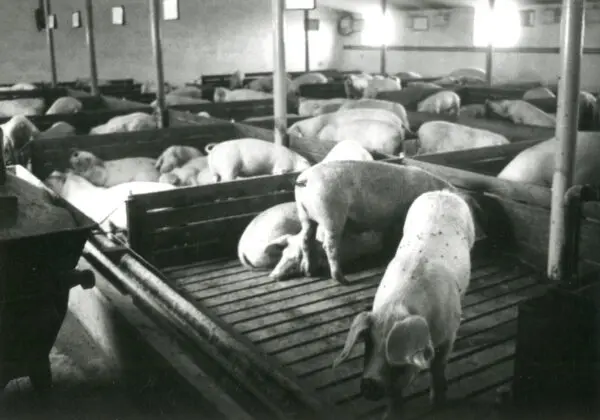
’'Livestock in transition' examines the industrialization of dairy and pig production and the driving forces that have shaped this development. Although industrialization has left significant traces in both food production and society, we still know surprisingly little about its historical course and consequences. With an interdisciplinary and methodologically innovative approach that combines cultural history, economic history and livestock science, the project sheds light on how the conditions of livestock and human-animal relationships were changed, and how industrialization changed the cultural understanding of livestock and their status as living cultural heritage.
The project is organized into three work packages, each with its own research questions:
Work package 1 examines how industrialization was implemented in Danish dairy cattle and pig production and what driving forces were behind the development.
Work package 2 examines the consequences of the industrialization of milk and pig production for the animals and their living conditions, as well as for the relationship between humans and animals in production.
Work package 3 examines how the industrialization of dairy cattle and pig farming affected the cultural perception of these livestock in society and their status as cultural heritage.
For a more detailed project description, see Livestock in transition: Industrialization in the stable and livestock as living cultural heritage in change.
The position
As a postdoc, you will contribute to all three work packages, with particular focus on work packages 2 and 3. You will have the opportunity to define your own project across the work packages or with particular emphasis on one of them.
The position will also include administrative tasks related to the project, including organizing meetings, workshops and seminars.
You will be employed at the Green Museum and affiliated with the museum's research and collections department. The museum houses a large research library, and a significant part of the source material is found in the museum's collections.
You will be provided with office space at the museum and are expected to be present at the museum regularly. Based on the project results, you are also expected to contribute with reflections on and collection of documentation, stories, interviews and objects from the history of industrialized animal husbandry to the museum's collections.
In addition to close collaboration with the museum's Head of Research and Collections and senior researcher in agricultural history, you will collaborate closely with researchers from the University of Southern Denmark and Aarhus University and will to some extent have the opportunity to participate in the research environments at both places.
The position also includes expectations that you:
- presents research results at conferences
- publishes in relevant scientific journals
- contributes with own publications and participates in joint publications with the research group
- contributes to the preparation of funding applications for new research projects within related topics