




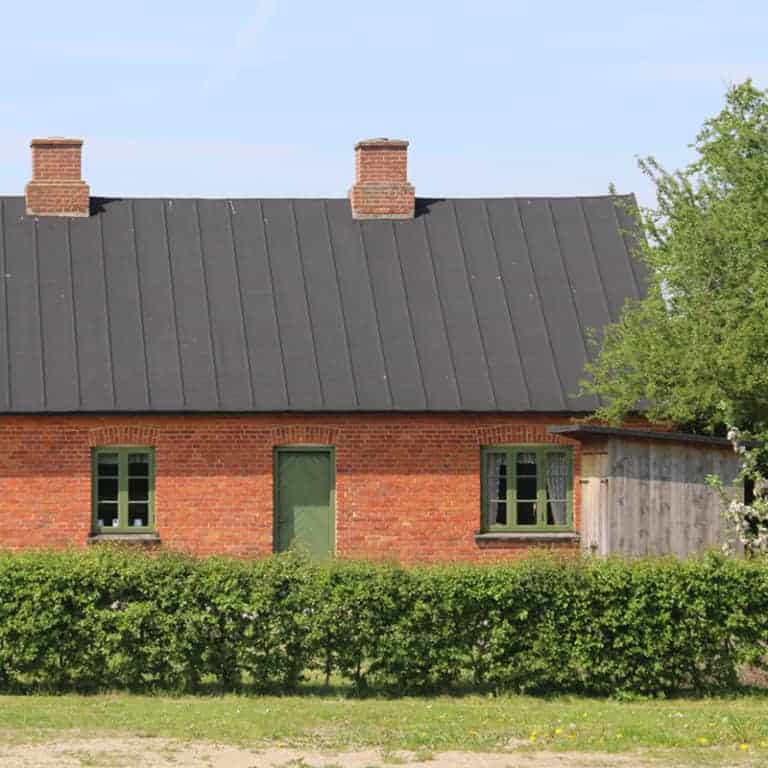
The house was built in 1909 for the Polish farm workers who worked at Gl. Estrup. It is a special house of very high quality.
The Polish House
The Polish House
The house was built in 1909 for the Polish farm workers who worked at Gl. Estrup. It is a special house of very high quality. However, it was rebuilt in 1918 because the Polish farm workers were no longer needed. In time, Danish farm worker families moved into the house.
The Polish law
In 1908, the “Act Concerning the Use of Foreign Workers in Certain Enterprises and Public Supervision Thereof” was enacted.
It quickly became known as the “Polish Law” because it primarily dealt with Polish seasonal workers. The law established both employment and sickness policies, but it also imposed specific requirements for the houses that Polish agricultural workers were provided with.
The Polakhuset at the Green Museum was built in accordance with the provisions of the law.
Timeline
1908 Polak Law
1909 The Polakhuset is built
1918 The house is rebuilt
1930 Danish farm workers live in the house
1950 The house is abandoned and stands empty.
2010 The house is renovated and opened to guests
The videos below can be viewed with both Danish and English subtitles.
The original entrance
Hear about the details on the facade of the Polakhuset. They show that the house is a quality building with high standards.
They also show that the original ground plan was changed and adapted to the situation after the end of World War I in 1918.
The original kitchen
Hear about the visible and colorful fads from the 1930s and how the stove with oven shows that the kitchen is the original kitchen of the house.
The new entrance
Hear about how the brickwork and plinth reveal why this second entrance is not the original one but rather the entrance established during the renovation in 1918.
The mysterious room
Hear about all the features from the 1918 renovation and how the room clearly originally had a function other than sleeping. What do you think the room was used for in 1909?
One of the four bedrooms
Hear about the bricked-up doorways, which are a direct consequence of the renovation in 1918, and how this bedroom meets all of Polakloven's requirements for space and hygiene.
