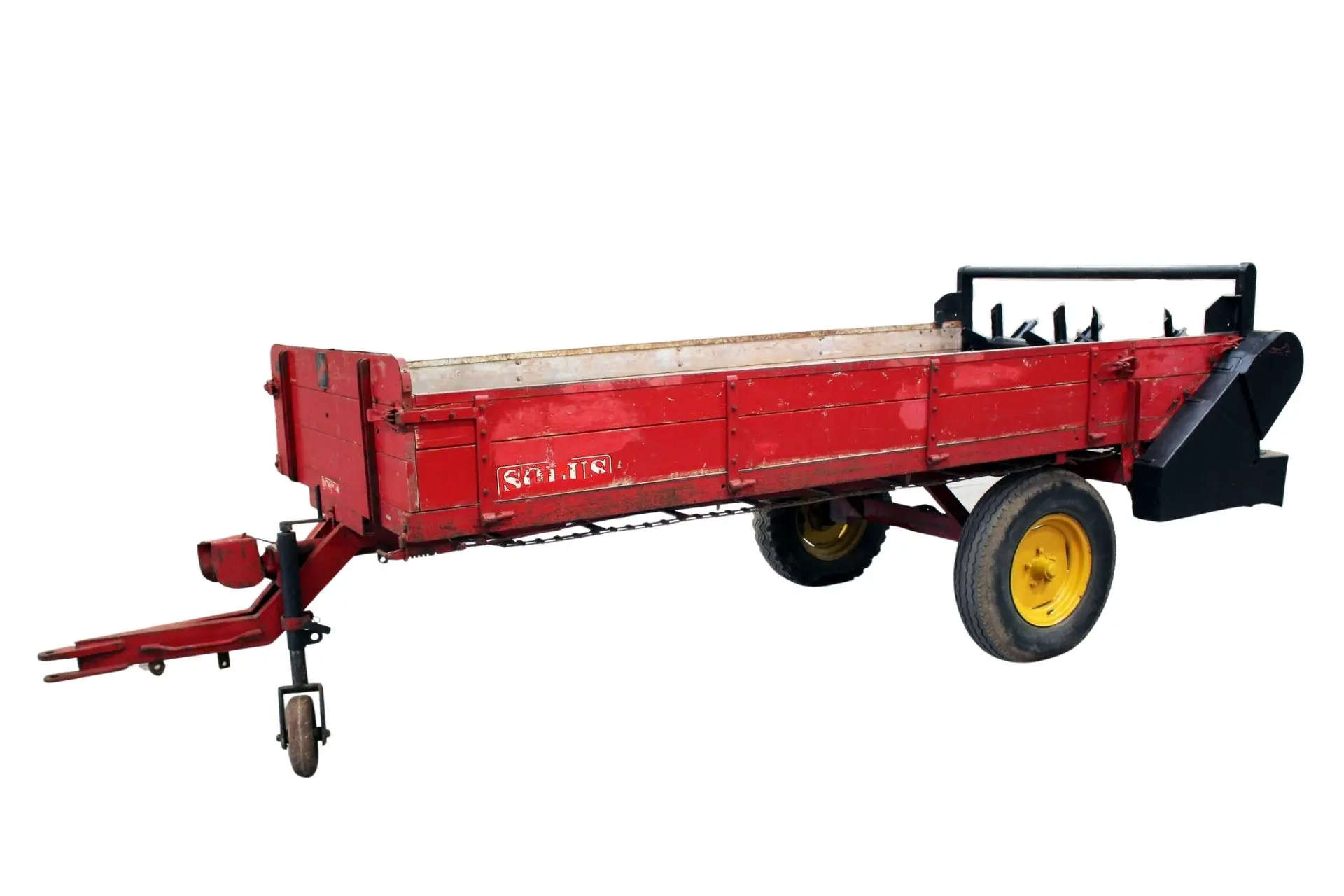
Unloader truck
The arrival of the tractor also meant the final farewell to the old horse-drawn farm carts with iron-shod wooden wheels.
Around 1950, several Danish wagon factories began producing flat wagons with rubber wheels and a flat bed that could be easily hitched to the tractor. Until then, such wagons had to be emptied of beets by hand and a grab, but in the 1950s, Danish engineers and machine contractors independently figured out how to transfer the traction power of a tractor to the unloading wagon. This way, the wagon load was pulled backwards with the help of chains. An inclined assembly line was now installed at the rear of the unloading wagon, which pulled the beets up and unloaded them into a beet ball or a beet house.
What had previously been a dirty and heavy job could now be done without any problems. If only you could figure out how to reverse the tractor and unloading trailer and had a hatch in your rowing house that fit the conveyor belt.
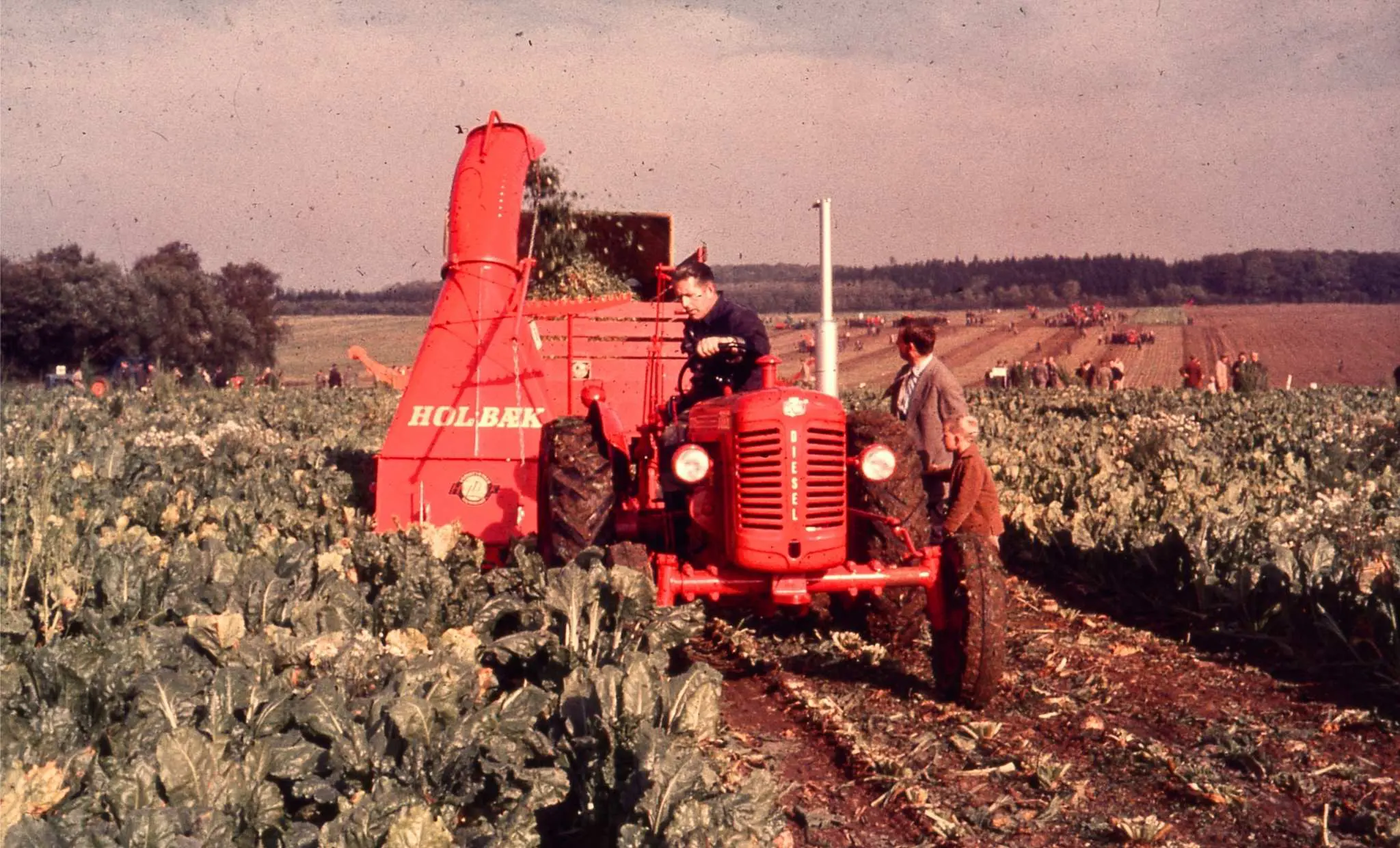
Green harvester/fine chopper
Before the beets could be pulled out of the ground in the autumn, the green tops had to be cut off by hand. This caused heavy arms and back pain, but in 1955 Anton Hindhede in West Jutland came up with a solution.
Hindhede had already acquired a Ferguson tractor, so he now built a harvesting machine that could be attached to the vehicle's three-point linkage. The first green harvester in Denmark was now a reality, because harvesting was exactly what it did.
Three sharp knives passed over a row of beets at a time. The knives could be adjusted to control how high the beet tops were cut. The beet tops were not allowed to lie floating in the fields, as the rapidly rotating knives threw them up into a dinosaur-like tube. From there, the beet tops were blown into a cart that was hitched to the green harvester.
Hindhede later sold his patent, and over time, green harvesters were developed and further developed that could not only cut beet tops, but also harvest grasslands.
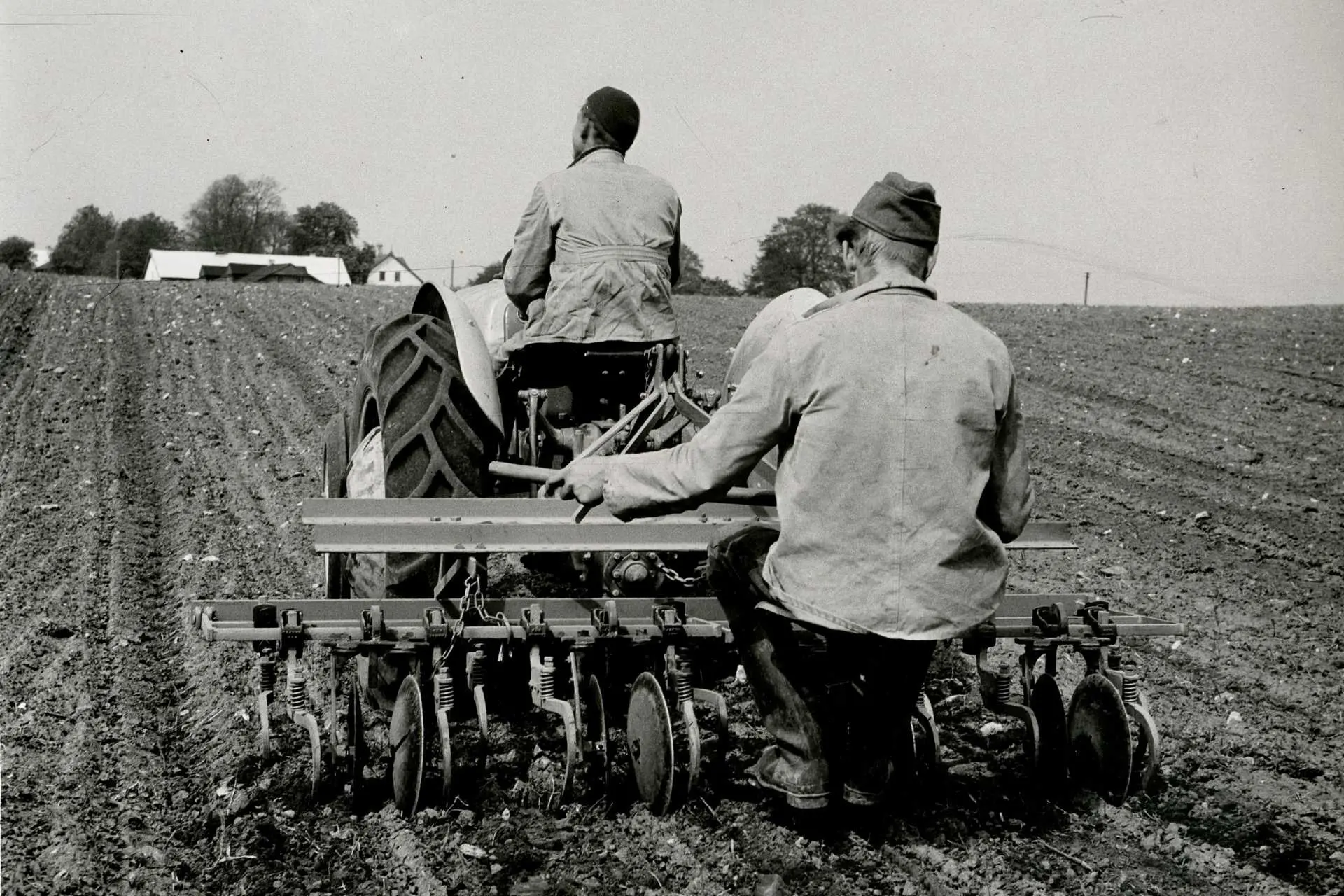
Rad cleaner
Row cleaning, where weeds were removed between the crops, was one of the field works where the horse actually managed to compete with the tractor right up until the 1960s. When cleaning between the beets, it was easier for a man to control a horse pulling the row cleaner than to sit on the tractor and not have an overview of where the row cleaner was swinging.
In order to make better use of the tractor, row cleaners were manufactured with four rows of tines, whereas the horse-drawn ones only had two. This allowed a man to sit behind the row cleaner and coordinate the row cleaner's movements with a lift arm. After all, it was both easier and more efficient than walking alongside the horse.
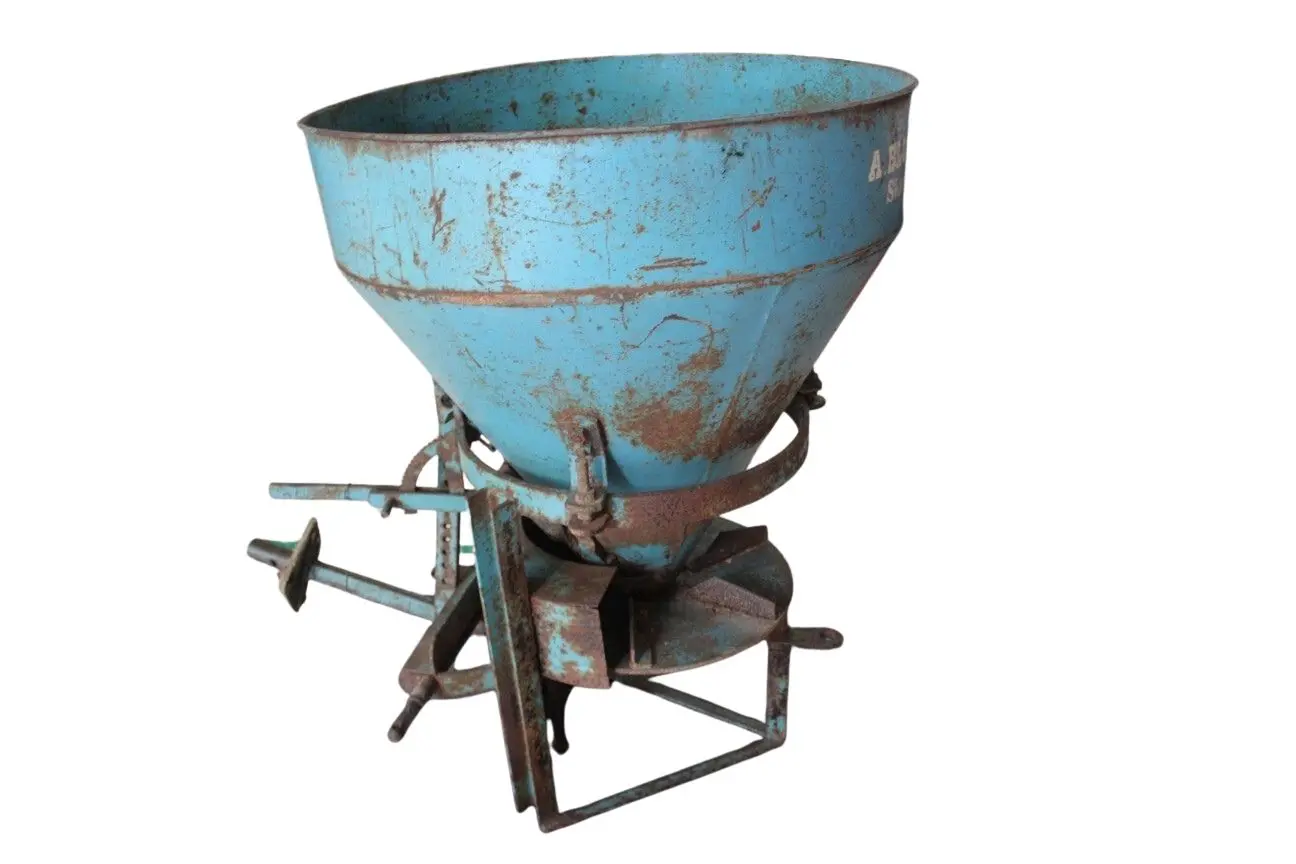
Centrifugal spreader
Because of its appearance, the centrifugal spreader was also known as a “coffee grinder,” but it was definitely not coffee beans that were poured into it. Instead, the spreader was intended for the fertilizer that was to be spread on the fields.
Its introduction in Denmark was closely linked to the arrival of the tractor in the 1950s and the availability of better forms of fertilizer. A centrifugal spreader could hold up to 500 kg of fertilizer, which was spread out via a rotating spreading disc under the container.
Some models also allowed the driver to regulate both the amount of fertilizer and the speed of spreading with the help of metal discs. A shut-off valve was also installed in the hopper, so that there was no risk of the contents falling onto the road or into the field where they were not supposed to be.