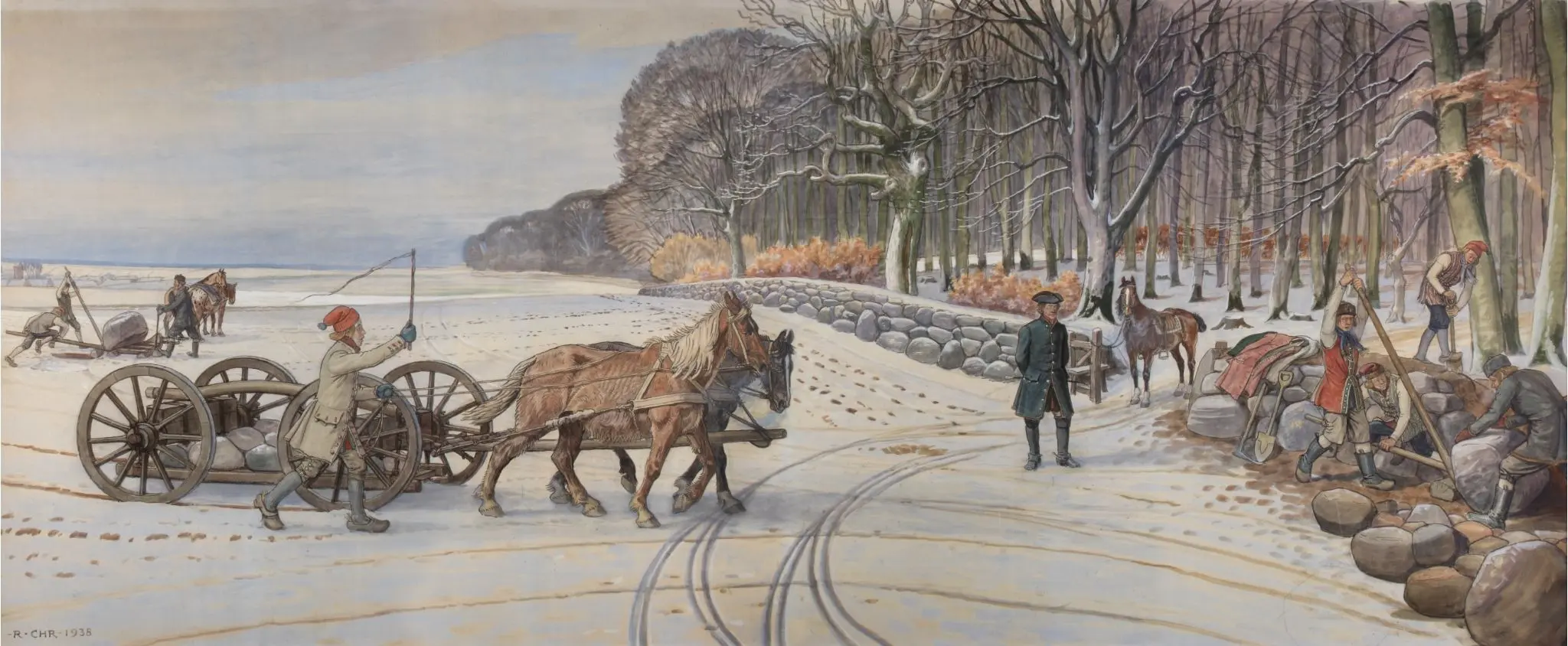
From field to fence
When the farmer in the years before the reform period ploughed his own or the landowner's fields, he not only had to slow down to chop away old tree roots with his axe or try to steer the heavy wheel plough around the countless puddles in the field. A third and equally difficult obstacle was the many large stones that lay scattered across the fields.
As early as the 17th century, farsighted people had long argued that the stones in the fields could be collected and reused to build stone fences that could serve as enclosures around fields, meadows and forests. However, the village community's working methods and traditions came into conflict in every way. Since the three-field system rotated the common fields annually between cultivation and fallowing for cattle grazing, it did not make sense to build permanent fences. Building stone fences between each of the individual farmer's many small plots would also slow down and make driving and field work more difficult.
Only with the exchange of agricultural land under the individual farm and the emergence of more and more self-employed farmers was there a real motivation to start clearing the fields of stones. Now it was only the farmer himself and not an ambitious landowner or the entire village who had to be taken into account. Every bit of the new and often expensively purchased land had to be utilized. At Faaborg, 50 farmers had removed so many stones from their fields in 1784 that they all had enough stones for their new fields to be fenced with stone fences. In connection with the exchange of land in Frederiksborg and Kronborg counties, the farmers collected enough field stones to build stone fences with a total length of approximately 98 km.