




A technological leap
The wheeled plough is possibly a Chinese invention that was introduced to Europe as early as the 5th century. Here it was to dominate field work for more than 700 years. The importance of the wheeled plough for Danish agriculture was revolutionary in every way and can only be compared to the arrival of the grey Ferguson tractor after the Second World War. But what was it that the wheeled plough could do?
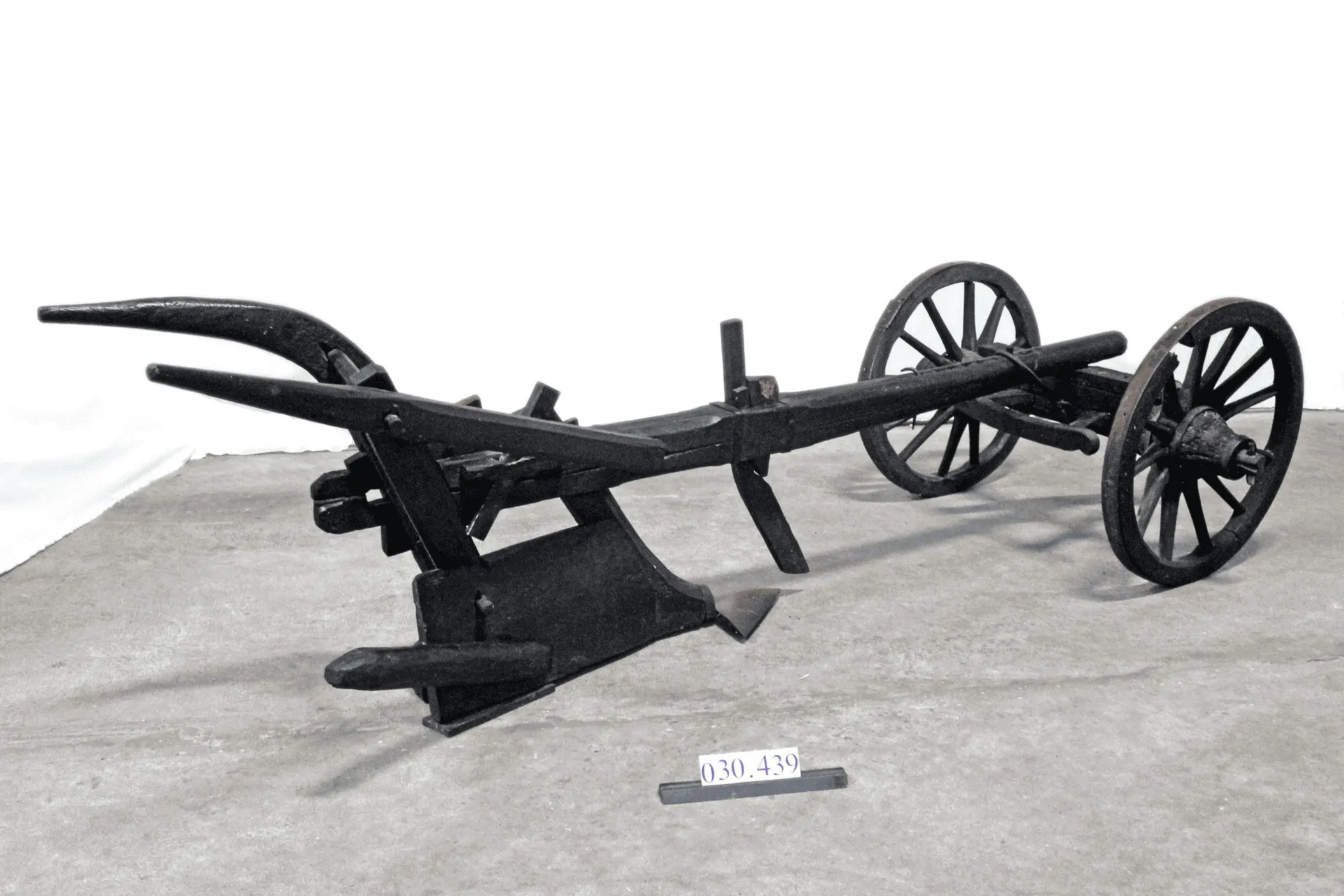
First of all, the wheeled plough was a technological leap. Especially when compared to other, more primitive types of plough. Such ploughs were able to scratch the soil, but could neither loosen nor turn it. The wheeled plough, on the other hand, could. Among its qualities was the knife or long iron, which cut a vertical cut into the soil and uprooted plant roots and weeds. In addition, there was the ploughshare, which loosened the soil, and finally there was the molehill, which tipped the cut soil to the side. For the same reason, it was enough to plough the field once. The fields that had to be ploughed also changed in character, as the wheeled plough was so heavy that it had difficulty turning and thus reaching the corners of a square field. The solution was instead to organise the fields into long strips. Here, the corners were far away, and you did not have to turn the wheeled plough too often.
Expensive and hopelessly outdated
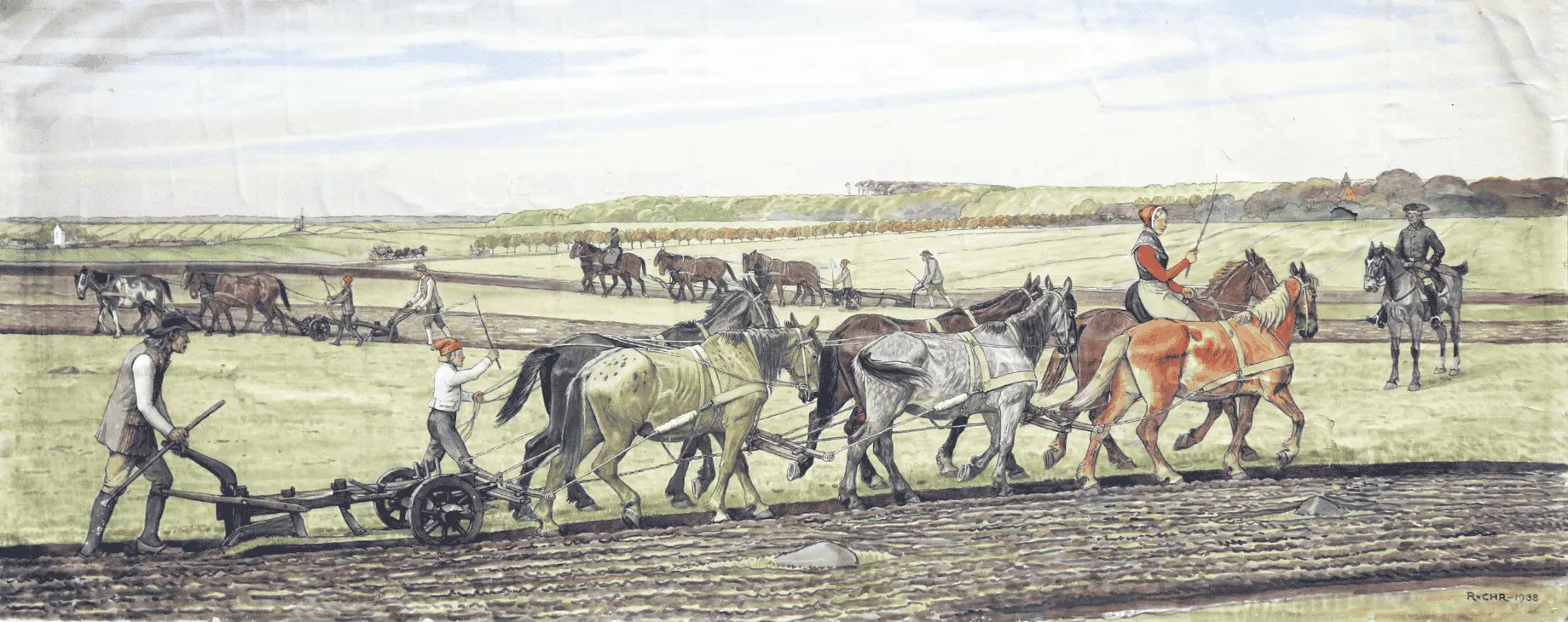
The wheel plough was a heavy field tool that required up to eight horses or at least as many oxen as traction and two ploughmen, one to steer the plough and one to lead the draft animals. Ploughing with a wheel plough therefore required considerable resources, and the many wooden parts often had to be repaired or replaced. For the same reason, it was often the case that several farmers or perhaps an entire village joined together to invest in such a wheel plough.
In the 1770s, reform-minded landowners and the academics of the Royal Danish Agricultural Society considered the wheeled plough expensive to use and hopelessly outdated. In short, it was a definite obstacle on the road to a more efficient and reliable Danish agriculture. Here, the light swing plough was both more efficient and time-saving to use. However, old habits could be difficult to eradicate, so it was not until the 1850s that the wheeled plough had to give way completely to progress.
