An education created by chance
When the Agricultural Society became involved in the training of new farmers at all, it was due to pure chance, which arose far from the society's meeting rooms in Copenhagen. From 1813 to 1815, the linguist and librarian Rasmus Rask had stayed in Iceland, where a local farmer had managed to establish a garden in the harsh Icelandic climate. Rask had been greatly impressed by this effort. Once back home in Copenhagen, the scientist therefore contacted the Agricultural Society to see if they could help the talented Icelander. Perhaps they could even send a swing plough to Iceland so that the skilled farmer could optimise his work output?
However, the company thought it was too risky an investment. Not least because they had information that no one in Iceland had ever seen or handled a swing plough. And who would operate it properly if that were the case? Here, however, the farmer with the green fingers got ahead of the worries. He wrote to the company on his own and suggested that his son visit Denmark. Then he could gain his own experience with Danish agriculture in general and the swing plough in particular. As said, so done. The Icelandic farmer's son visited Denmark in 1816, learned a lot about horticulture and then returned home.
A whole new generation of farmers
The Agricultural Society now thought that perhaps the same model could be used to advantage in Denmark. Perhaps this could be the way to educate a whole new generation of farmers? At this time, however, the kingdom's defense was still built on the efforts of farmers as soldiers. You could not both serve as a soldier and attend an education. Before you could begin recruiting new students, you therefore had to ask Frederik VI for permission to exempt the sons of farmers on a future agricultural education course from their military service? Fortunately, the king gave his approval and then you could start working on getting Denmark's first agricultural education course on track.
The company wanted to focus on young men who had themselves been born and raised on a farm. This would allow them to serve as good examples for other farmers in their home regions.
The idea was that each student would receive education, board and lodging from progressive landowners, priests and farmers who were already engaged in the work of the agricultural reforms. The curriculum was structured as a three-year course, where the students would become familiar with the work in the fields and stables through practical work assignments.
Potato balls and cattle feed
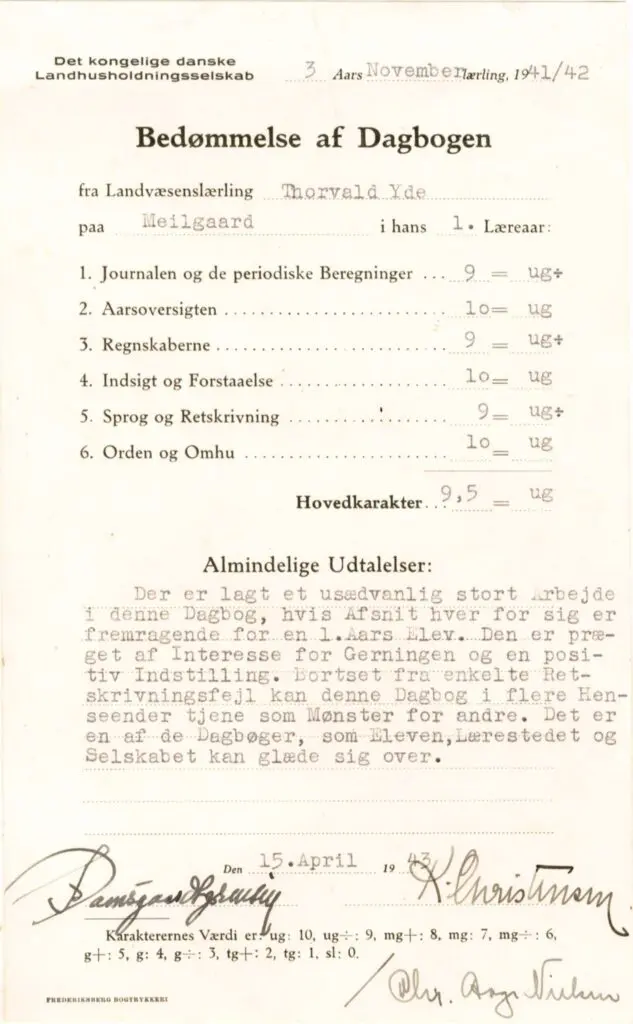
However, the education was not only practical. In the spirit of the Enlightenment, with its focus on observations and rational decision-making, the students were also expected to form their own thoughts about all the new things they saw and learned. This meant that the company required that the students write diaries, which were then submitted for assessment in Copenhagen every six months.
In 1820, the first group of twelve students were ready to begin their education. They came from farms and villages around Copenhagen, Randers, Ringkøbing, Svendborg, Odense, Vejle, Roskilde and Aarhus. It is clear from the students' diaries that they had learned to plant windbreaks and build potato mounds around the country, while there had also been time to experiment with new mixtures of cattle feed.
The first group completed their education in 1823. It is difficult to say whether the first 12 students managed to live up to the Agricultural Society's vision that after completing their education, the students could contribute to shaping a whole new generation of farmers as good examples.