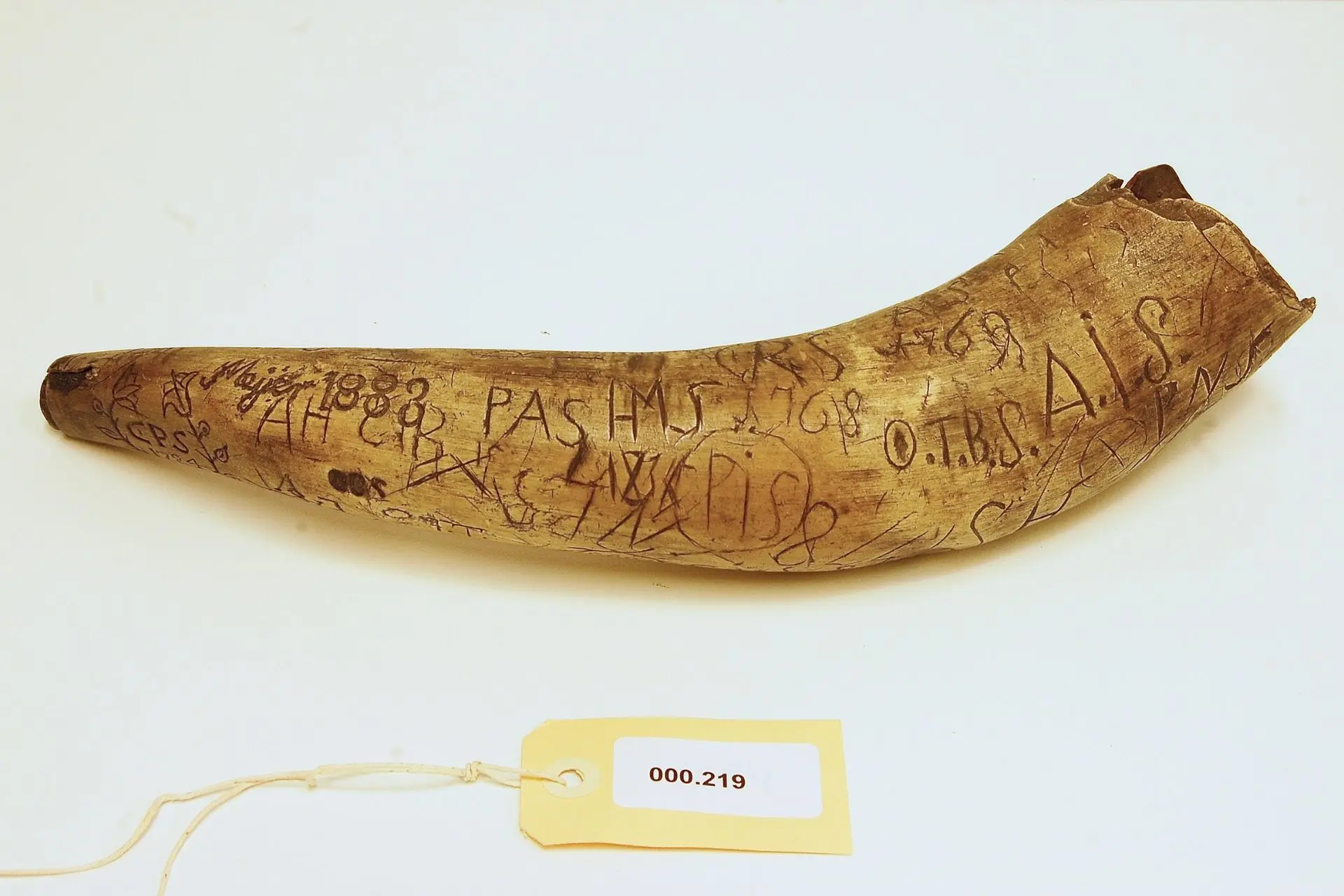
City horn
The core of the village community was the town or street assembly. Here the farmers of the village met to discuss common matters. The leader of the town assembly was the alderman. When a town assembly was to be held, he called people together by blowing the town horn. Such a town horn could be made of cow horn, wood or copper.
This town horn, with its mouthpiece missing, originates from the village of Gladsaxe on Zealand. The dates and inscriptions on the horn indicate that it was in use at least from 1758 to 1867.
Care
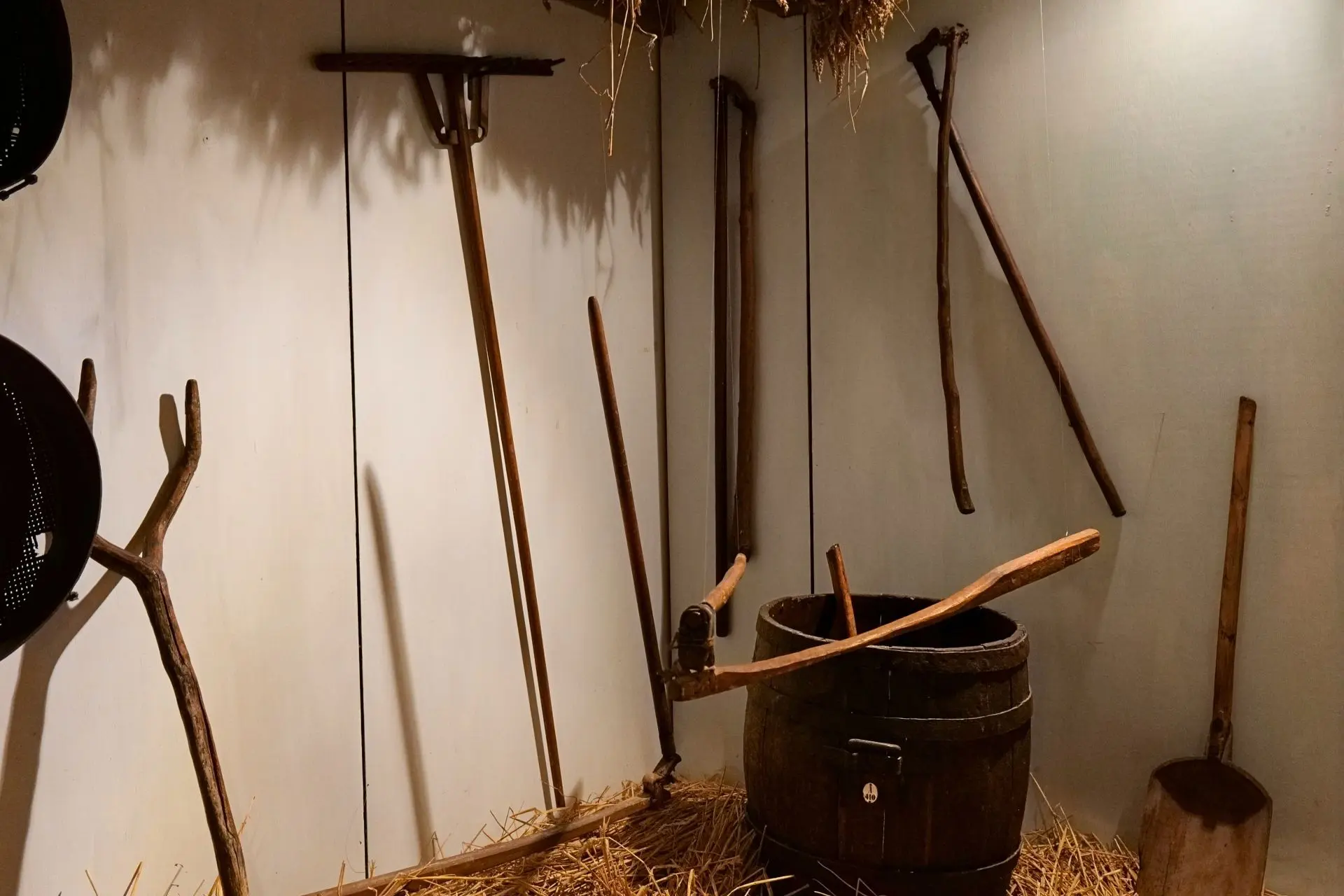
Once the grain was harvested and stored in the barn, the kernels had to be separated from the straw. Until the mechanization of agriculture in the 19th century, this work was done with a flail like this one.
A flail consisted of two sticks tied together with a pivoting hinge. The flail was used to thresh the grains by hand. The grains were then torn together and collected for further processing.
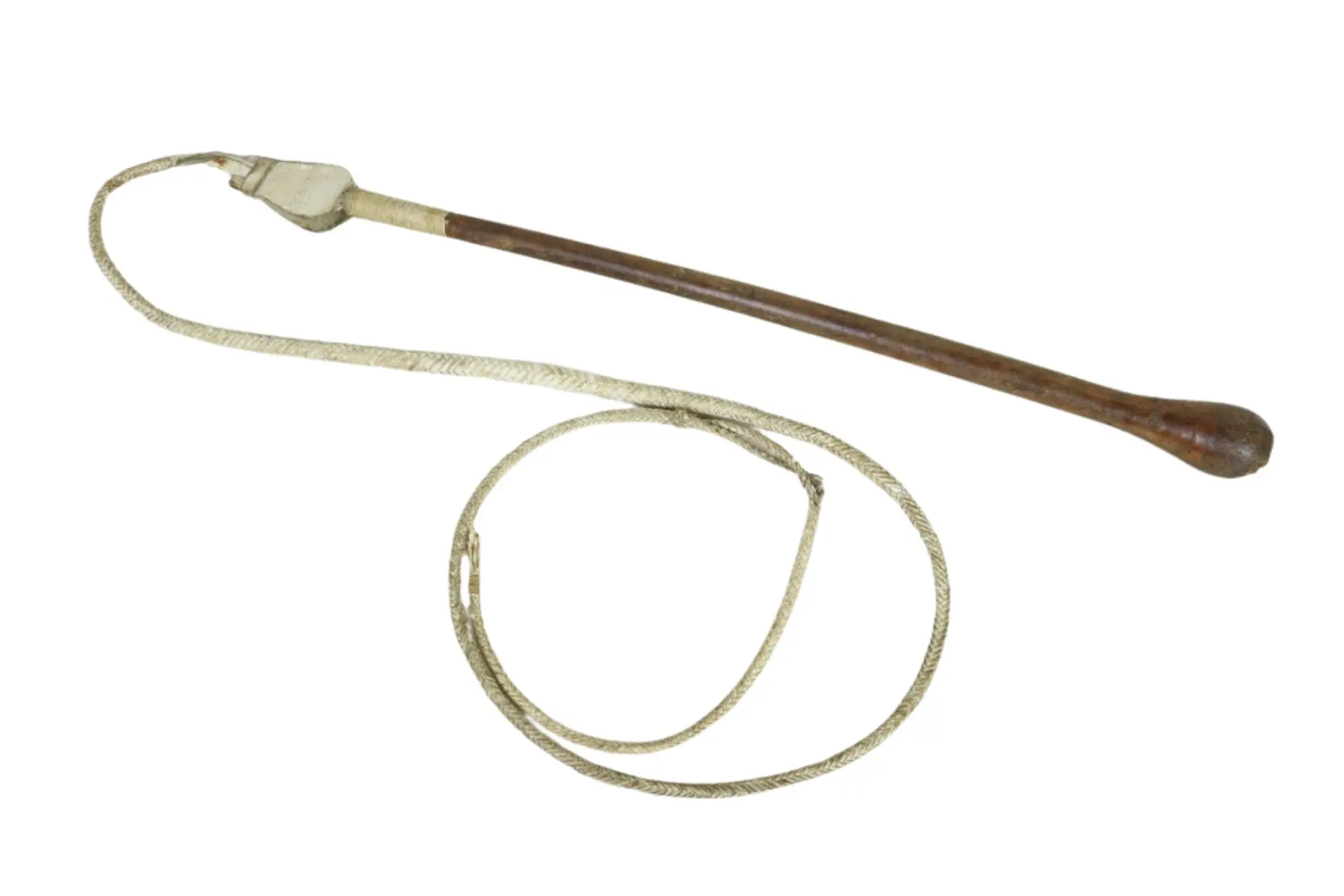
Dog whip
In the first comprehensive national law Danish Law, published in 1683, it was stated that every family man had the right to beat and punish his servants. Since the serfs did indeed serve the landowners, the law was read in such a way that every landowner was also within his right to punish his serfs. This meant that work-shy or recalcitrant farmers and their families risked being beaten if they did not do their job properly. The punishment could be carried out with a dog whip like this, if the landowner or his riding bailiff did not use their stick, a clenched fist or whatever else was at hand.
It was not until 1791 that a new law was passed that prohibited landlords from beating peasants. However, there was still freedom of speech if it was felt that peasants, farm workers and servants needed a slap in the face.
Surveying equipment
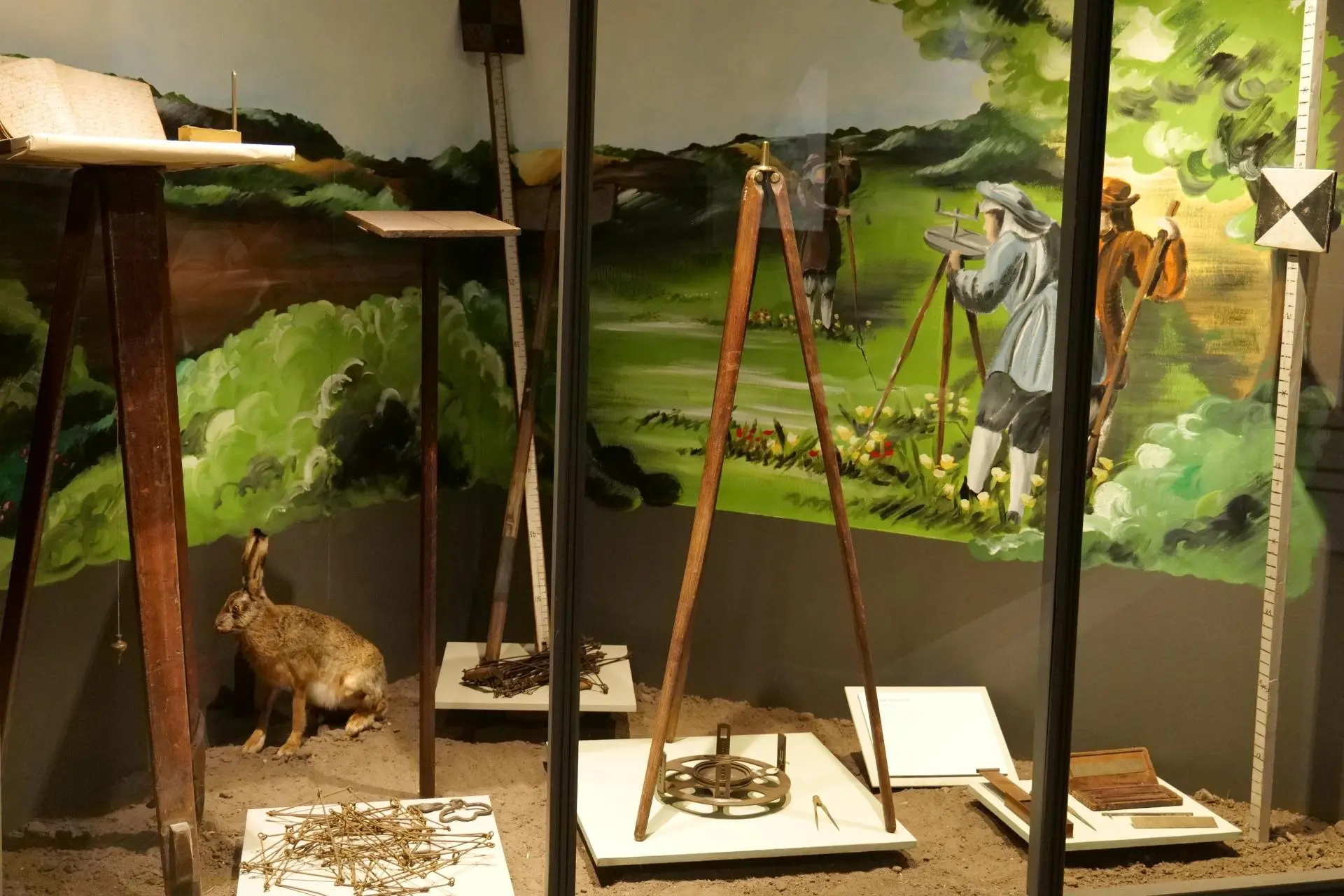
Once the decision to replace a village had been made, a great deal of administrative and practical work began. The main thing was to ensure that the land was distributed as fairly as possible, so that no farmer was cheated.
The major task of surveying and registering was left to professional surveyors, most of whom had studied at the University of Copenhagen.
The surveyor's most important tool for measuring the length of the land was a steel chain. It had a length of 12 meters, which was divided into links of 30 cm. The pegs were used to secure the chain in the ground, while the functional handles at each end made the chain easy to handle. In addition, there was a measuring table and ruler. All results were immediately written down in the journal they brought with them. The information was later transferred to new and large maps that outlined the landscapes of the new society.
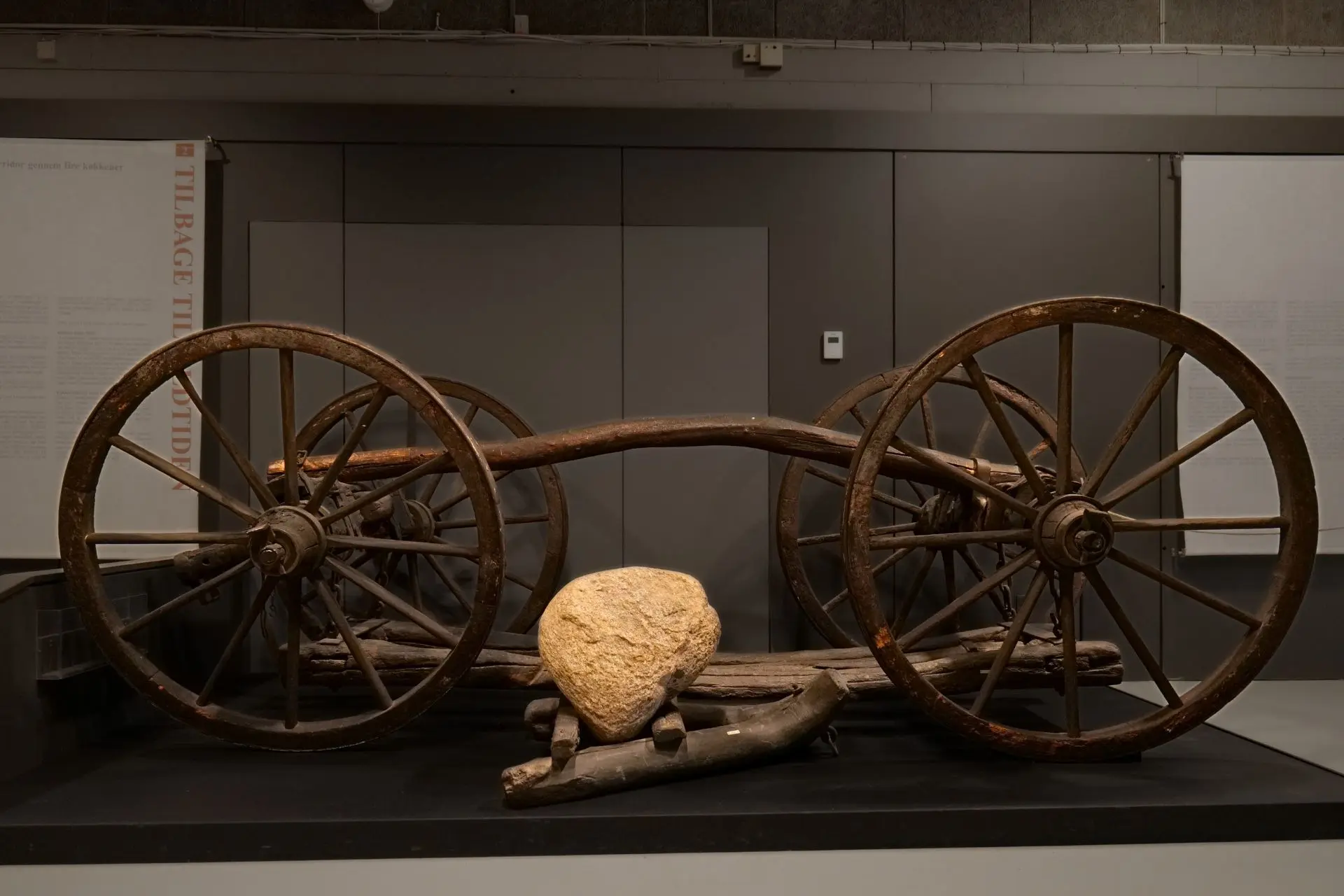
Stone wagon
Moving the farm from the village often meant that the new fields had to be cleared of large stones that had been there since the last ice age. For this purpose, a stone cart like this one from 19th-century Zealand was used. The cart worked in such a way that the long wooden poles on the bottom of the cart could be loosened at the back via iron chains. Out in the field, the stones were towed onto the poles and then driven away. Moving field stones was difficult and heavy work for both people and draft animals, but it was worth it. New agricultural land became available, and the stones could be reused to build fences that enclosed fields and forests.
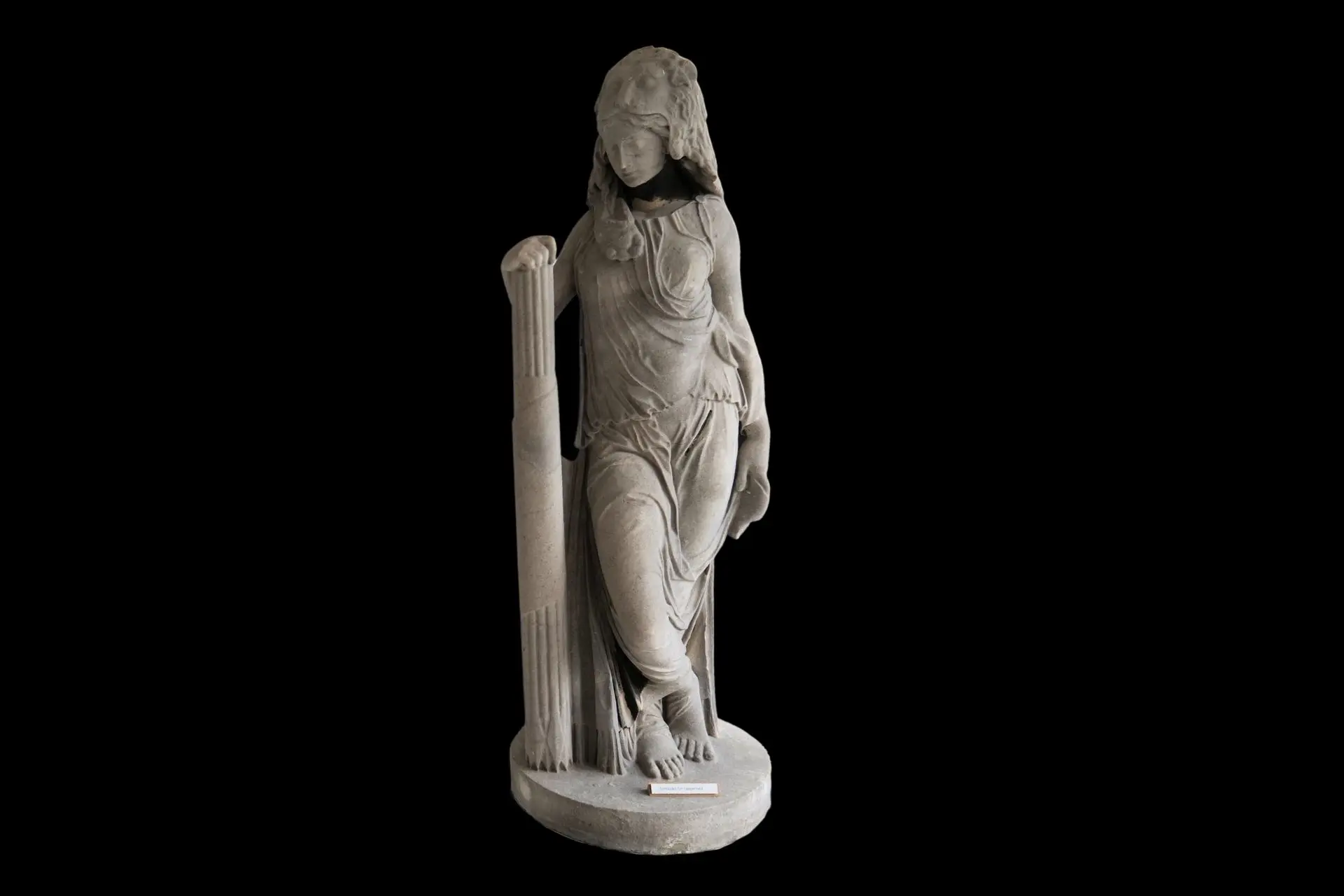
Bravery – Statue from the Liberty Pillar
In the ancient world, bravery was personified by the hero Hercules – dressed in a lion's skin and armed with a large wooden club. Here, the male superhero has been replaced by a woman. The lion's skin is still in its rightful place, but the fierce wooden club has had to make way for a bundle of spears wrapped in a flag. This is because the artist behind the work wanted to show not only bravery, but also unity. This is where the flag plays a role. It was supposed to symbolize that this was not only a brave but also united people who stood guard over the land reforms and formed a common front against all external enemies. Up until the 1840s, only young farmers' sons were drafted for military service. Therefore, the spears and flags may also contain a hidden allusion to the important contribution of the rural population to the defense of the fatherland.
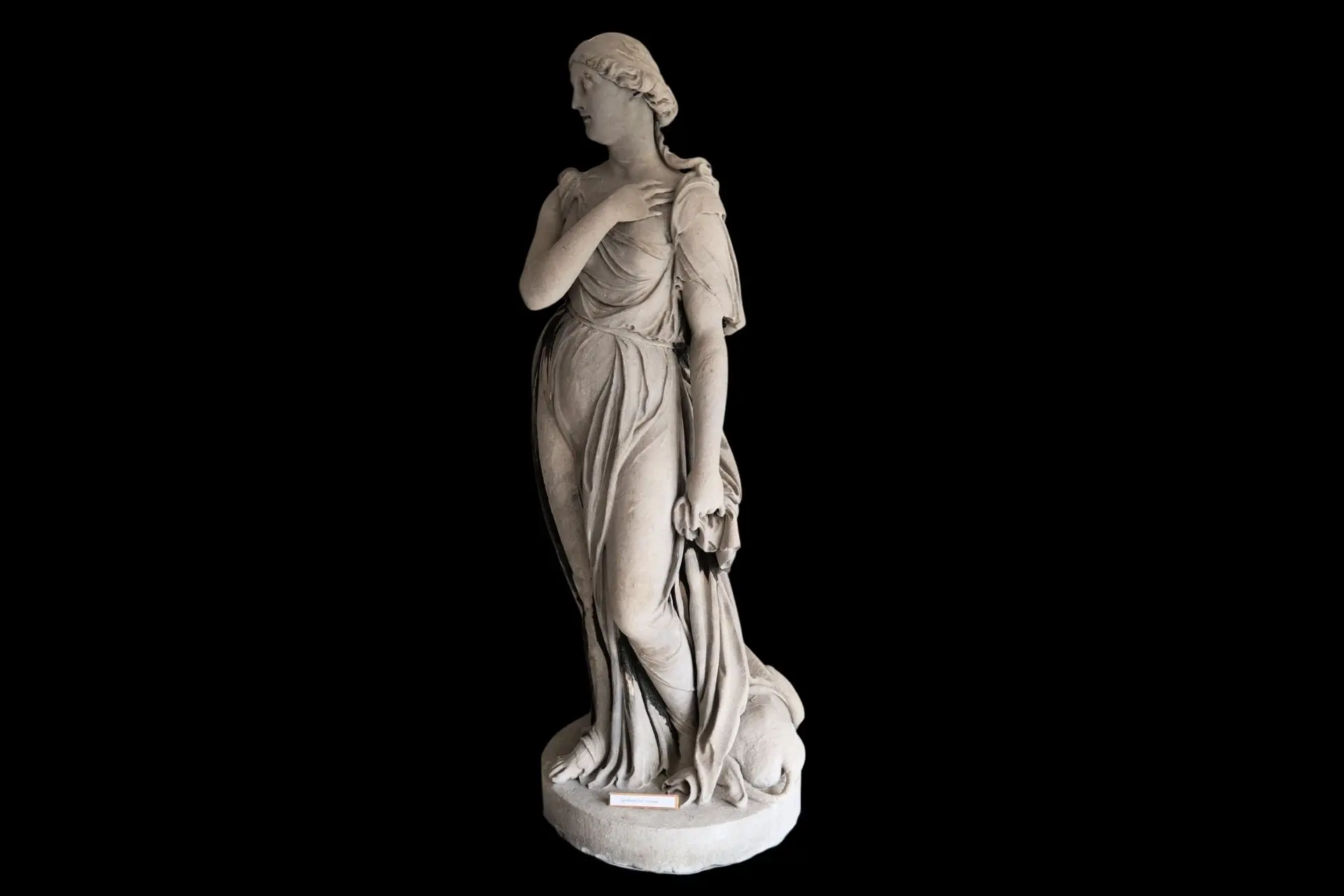
Allegiance – Statue from the Liberty Bell
The statue, Loyalty, stands with her hand on her chest close to her heart, which is meant to emphasize her sincerity. Behind her, but almost hidden, lies a large dog with its head resting vigilantly on its front paws. Since ancient times, the dog has been the living and walking symbol of fidelity and vigilance, and so it was in the 18th century.
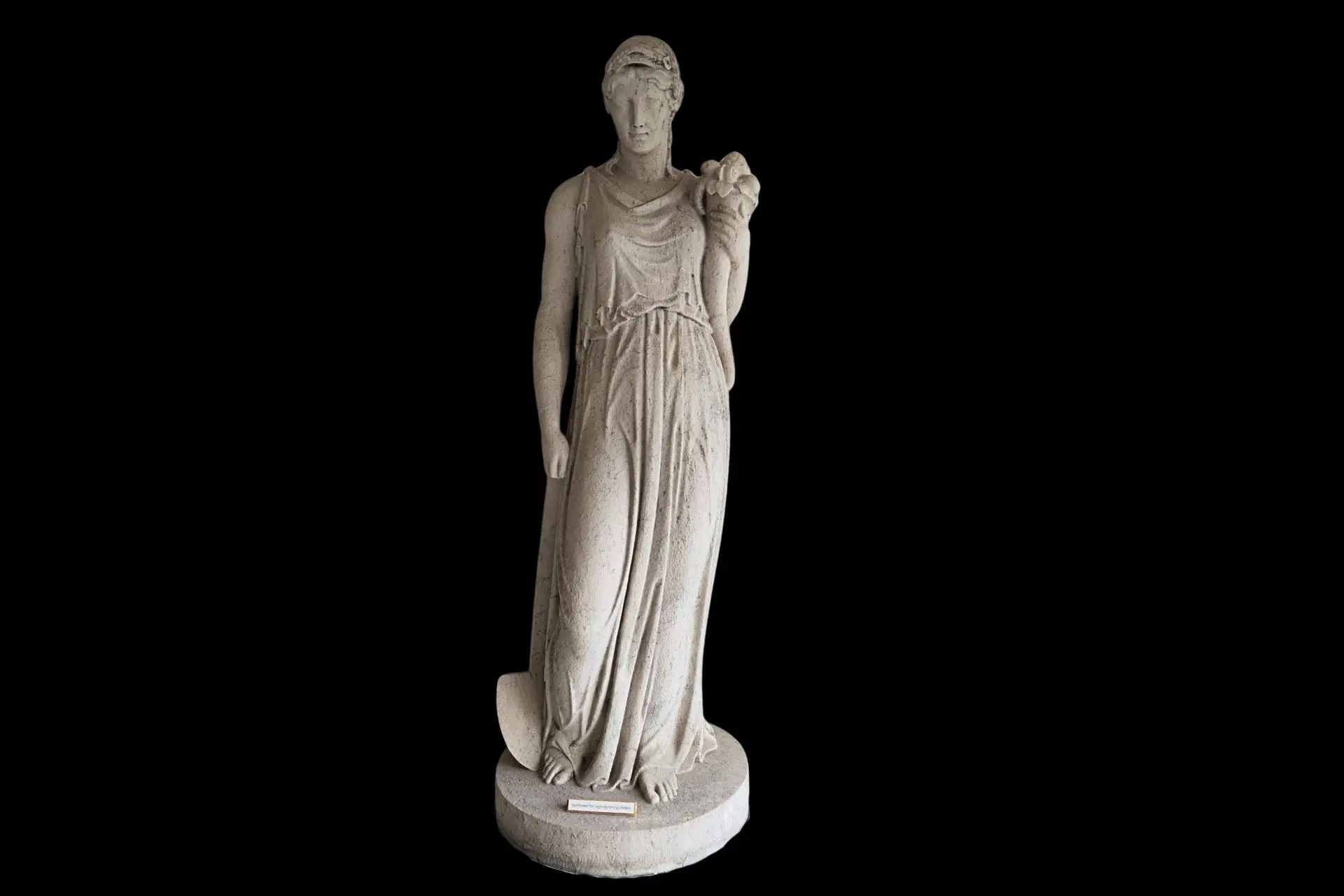
Farming Diligence – Statue from the Statue of Liberty
This is the only one of the Statues of Liberty that can be said to have a direct relation to agriculture. Everything about the statue tells us that it is Ceres who comes to meet us. She was the Roman goddess of grain, other crops and all other agricultural life. Ceres also symbolized fertility. For the same reason, she holds a cornucopia in one hand. The Statue of Liberty was intended as a monument to the reforms that were to make Danish farmers more efficient. Despite the tangible symbolism, Ceres was written out of the equation. Instead, the statue was renamed “The diligence of farming” as a symbol of diligent farming, and she was equipped with a plow, the farmer's most important work tool.
Unlike the other three statues, the Farming Diligence is a copy. This was because the statue in 1911 was so damaged that a new version had to be made.
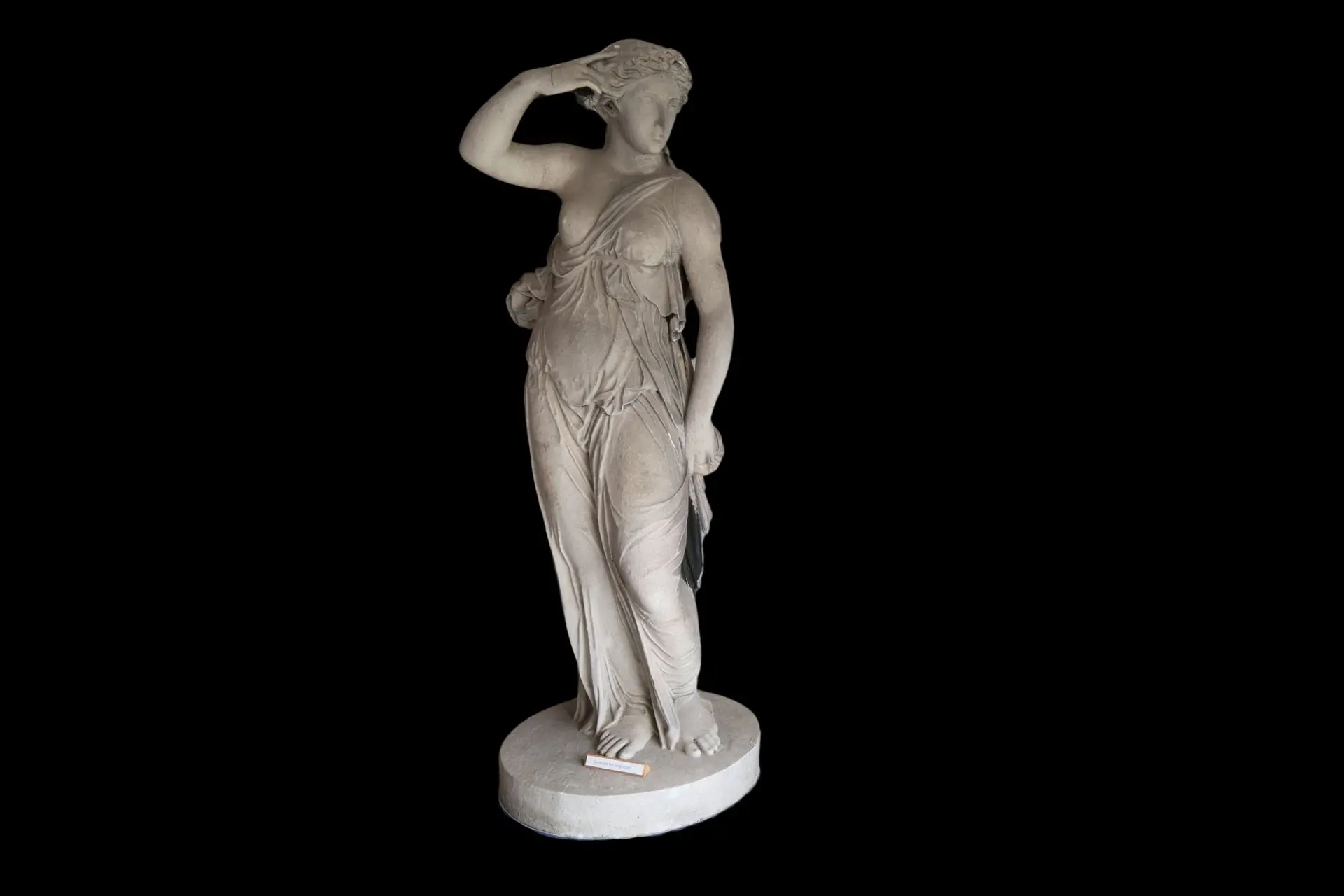
Civic Virtue – Statue from the Liberty Bell
On the Freedom Pillar, civic virtue is depicted as a woman crowned with a wreath of oak leaves. The oak tree in particular signaled strength and unwaveringness. In short: durability. Here, the sculptor had quite deliberately framed the regulation on the abolition of the Stavnsbandet. Here it was stated in black and white that the regulation was to ensure solid civic virtues such as a sense of responsibility and solidarity between the king and the people. Civic virtue thus documents the hope that these promises would prove to be just as solid as the oak tree.
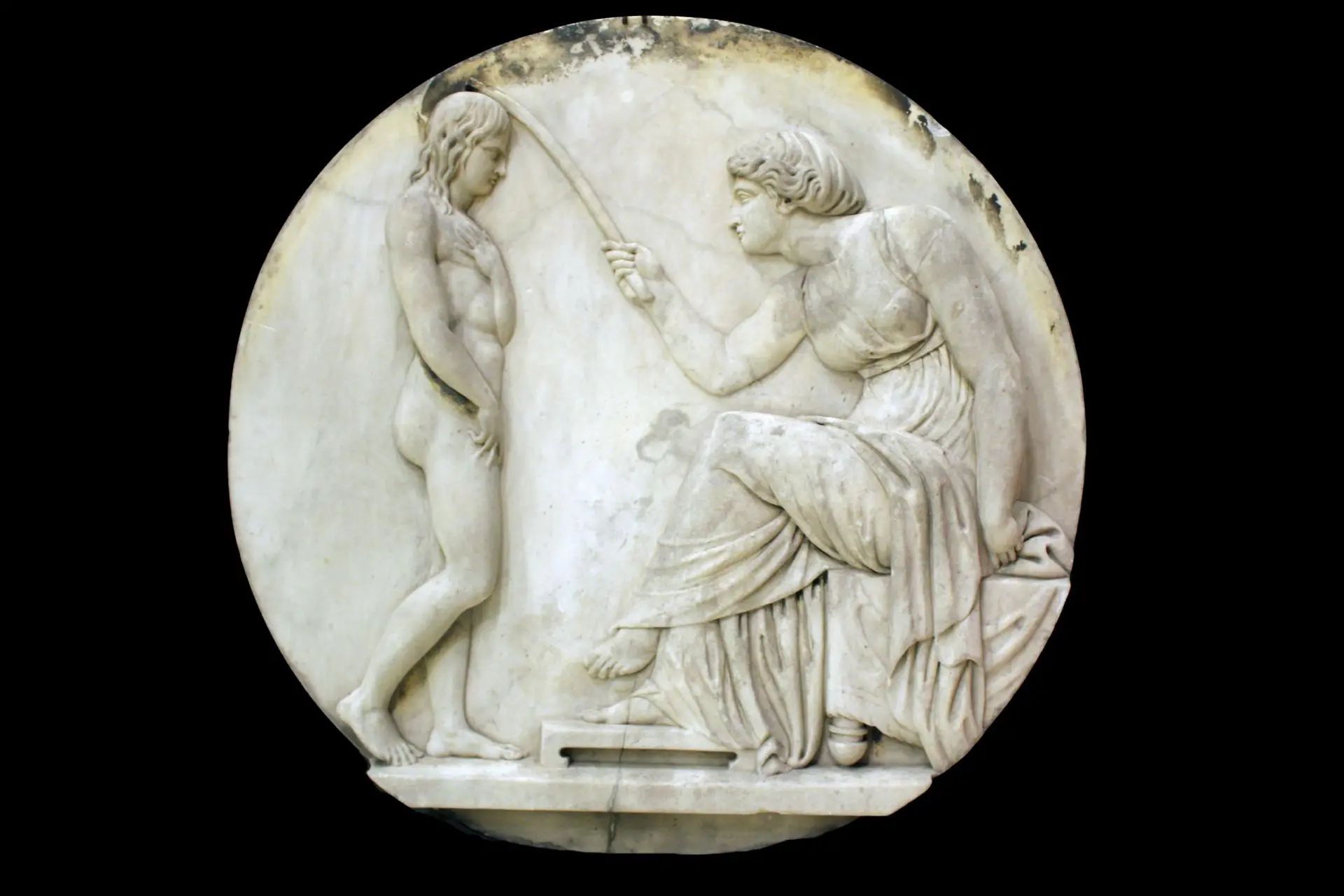
Slavery is abolished – Relief from the Freedom Support Fund
The pedestal of the Statue of Liberty is decorated with two carved reliefs in marble. One of these is titled “Slavery is abolished”. The artist drew inspiration from the Roman Empire, where slaves could be set free if their foreheads were touched by a vidicta – a freedom rod. Here, the motif can be interpreted as meaning that the seated woman represents Denmark or the state, which with the freedom rod lifts the bondage of the rod and thus grants the peasant his freedom.
The Genius of Justice – Relief from the Liberty Pillar
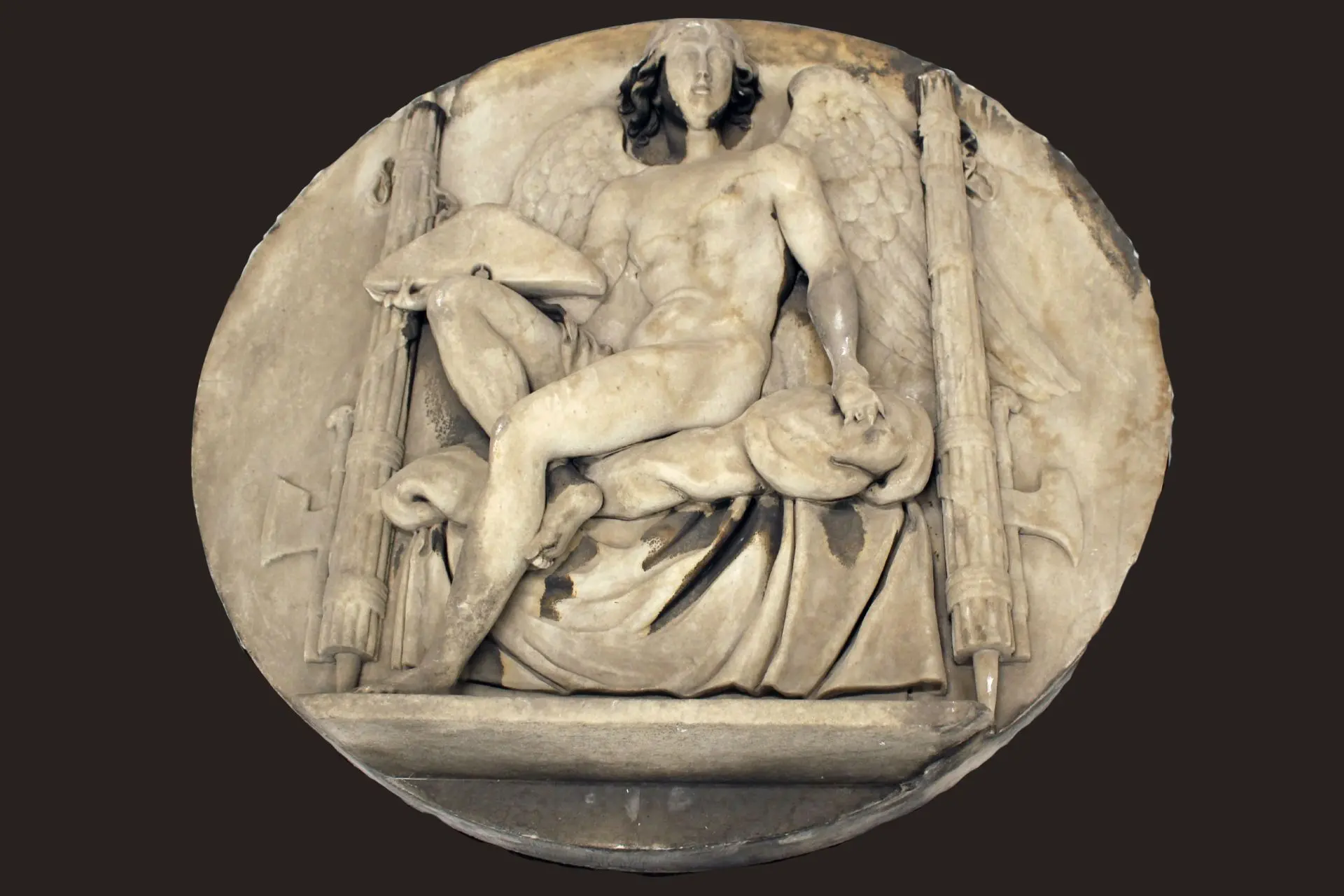
The pedestal of the Statue of Liberty is decorated with two carved marble reliefs. The second is entitled “The Genius of Justice”. In modern Danish it can best be translated as the Spirit of Justice. While there were probably landowners who were scheming in the corners, most people considered the abolition of the suffrage as a just act.
The spirit is depicted here as a winged god sitting on a throne. One of the great role models for 18th-century intellectuals was Rome during the days of the Republic, which is why the throne is made of fasces. Fasces were bundles of thin sticks with axes in them that served as the Roman officials' badges of honor. What you should pay special attention to here is the spirit level that balances on the spirit's knee. It stands perfectly straight, symbolizing that nothing can shake justice.