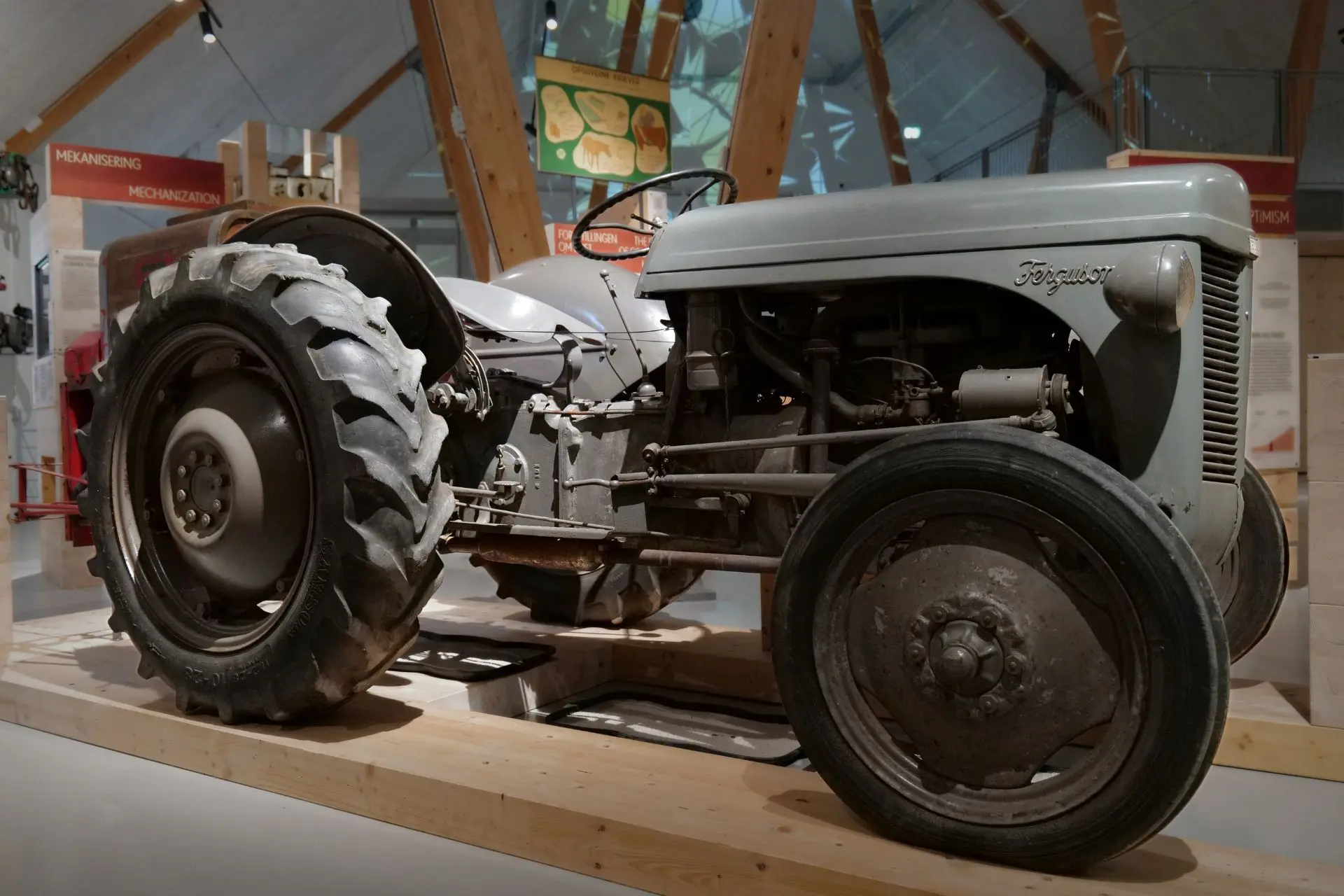
The little gray one
If one were to summarize the history of Danish agricultural mechanization after 1945, the Ferguson TE-20 tractor model cannot be ignored. This can be explained by the economic aid program “Marshall Plan”, which the US Secretary of State George C. Marshall offered to Western Europe in 1947. The intention of the plan was partly the economic reconstruction of Europe after the Second World War and partly to curb the influence of the communist Soviet Union on the European continent. The path to more growth and more prosperity was through an efficient and mechanized agriculture that produced plenty of food and was not dependent on traditional and slow horsepower. In Denmark, this meant that 6,500 tractors of the TE-20 model were received via Great Britain as early as 1948.
But what exactly could this tractor do? First of all, it weighed no more than 1100 kg. The low weight meant that the tractor could drive in both loose and soft soil. Since the model was so light, it also meant that it did not use much engine power on the tractor itself. These could, on the other hand, be used to pull the plough, harrow and other field implements. In relation to the driving and handling of the field implements, the Ferguson tractor had a completely unique function: the so-called three-point suspension. This suspension meant that you could raise and lower the attached field implements via a lever by the driver's seat. At the same time, this system made it possible to regulate how deep the plough should go into the ground, and the light vehicle could drive into all corners of the fields. No more plough-free areas and "holidays" in the field. Everything could be cultivated, which naturally gave better harvest yields.
Danish farmers in the 1940s and 1950s were used to horses and carts. Therefore, very few people had previously driven or even seen a tractor. Here, the Ferguson TE 20 had the advantage that its steering system was not much different from a passenger car of the time, which some Danes, despite the war and a society of scarcity, had had experience with. The factory had also deliberately kept the tractor's steering system as light and uncomplicated as possible. For example, the brake and clutch points were so weak that even a child could drive the tractor. The engine on the Ferguson tractor was no more complicated than on cars of the time, and since only two types of screws and nuts were used, it was affordable for the local village blacksmith or car mechanic to repair it. In terms of usability, structure, construction and maintenance, the Ferguson TE 20 was a winner in every way.