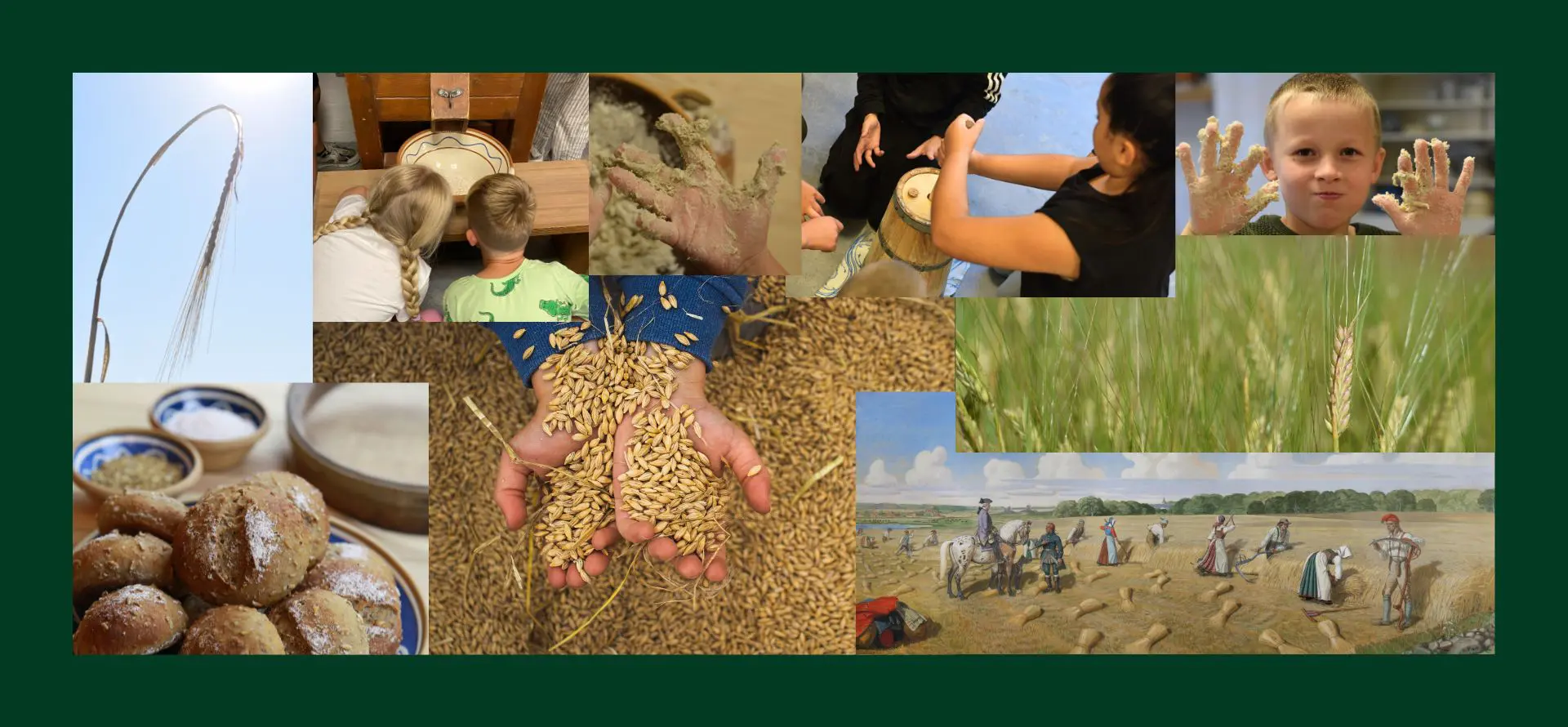
A teaching course about grain and Danish agriculture
For 6000 years we have grown grain in Denmark. In the Neolithic Age we grew wheat and barley. In the Bronze Age we also began to grow oats. And at the end of the Iron Age rye came to Denmark. Denmark is a nation raised on grain and to this day we in Denmark still produce between 7-10 tons of grain every single year.
We use grain in our bread, beer and groats, but the majority of our production is used as feed in livestock production. This means that with the help of grain we can also get meat, eggs and milk on the table.
In the GOLDEN GRAIN course, students will work on the history of grain in Denmark and do agricultural activities adapted to the season.
We will work with grains, types of grains and the importance of grains in Danish history. And then we will use the grains to bake delicious buns.
The course starts with an age-appropriate dialogue-based tour of the exhibitions. The focus is on the farmer's self-sufficiency and especially the importance of grain, the harvest and livestock for the farmer, farm life and the traditions associated with the harvest. The students learn about the four types of grain and their uses past and present.
We emphasize the history of grain, grain as a means of prosperity and development, the importance of grain in war and peace, and the origin and importance of ancient grain varieties for the future. When baking, students can choose between different ancient varieties and experience differences in taste, appearance, and consistency.
AUTUMN MUST BE IN THE HOUSE (AUG. + SEP.)
During the harvest season (around August + September) there will be an additional charge of 400 DKK to cover the costs of an extra facilitator. The activities here take place in the field, where the students will harvest with a sickle, thresh with a flail and clean in a sieve as they did in the past. Buns are still baked.
TARGET GROUP
School enrollment
SUBJECT
Students' all-round development
Danish
History
Time consumption and indicative program
4 hours (if you want to have time to explore the exhibitions on your own, you must make sure to set aside extra time for this after the course.)
GUIDELINE PROGRAM:
9.00: Arrival at the Green Museum
9.15 – 10: Guided tour
10 – 10.30: Break and packed lunches
10.30 – 12.30: Agricultural activities + bun baking
12.30 – 13: End with buns, juice and freshly churned butter
Number
Max 25 people/class
Price
1500 kr
+ 400 kr during the harvest season (approx. Aug. + Sep.)
NOTE
Bring packed lunches – there is no possibility to buy food at the museum.
Competency goals
- The student has knowledge about the basis of life and production in the past and present.
- The student can gain knowledge about history through the use of historical scenarios.
- The student can put their own and others' historical narratives into perspective in time and space.
- The student can relate changes in everyday life and living conditions over time to their own life.
- The student can compare significant features of historical periods.
- The student can alternate between listening and speaking.
- The student has knowledge of turn taking.
- The student can use spoken language in conversation and collaboration.
Teaching materials
To continue working with grain and agriculture, we at The Green Museum have developed this print out that can be used as an extension of a GOLDEN GRAIN course.
In addition, further work can be done and more information and material can be found on the following pages: