




Villemoes Fertilizer Spreader

Villemoes fertilizer spreader as it stands on the Green Museum's magazine.
The museum's collection includes one of the most popular fertilizer spreaders, the Villemoes Fertilizer Spreader. It is not part of the visible exhibition, but is stored in one of the museum's magazines.
The invention of industrially produced fertilizer in the early 1900s revolutionized agriculture. In Denmark, fertilizer consumption increased, especially after World War II, from 79 million kg in 1945 to 478 million kg in 1970.
Up until World War II, fertilizer was often spread with shovels from a cart, but from the early 1920s, several experiments were made with mechanical fertilizer spreaders, which were far more efficient. Many of the first fertilizer spreaders were, however, expensive and required a lot of maintenance. In the 1930s, new, better, lighter and cheaper fertilizer spreaders began to gain traction among Danish farmers, and the museum's collection contains one of the most popular, namely Villemoe's Artificial Fertilizer Spreader.
Unlike other spreaders, Villemoes was a so-called disc spreader, which worked by the discs leading the fertilizer out of the fertilizer container through openings in the rear wall, after which the fertilizer was distributed over the discs by means of a rotating shaft. The original Villemoes spreader was developed by Diderik Villemoes in the late 1920s and manufactured at Villemoesgård Maskinfabrik, but from around 1930, Skive Jernstøberi og Maskinfabrik (later A/S Gyro) took over the manufacture of the fertilizer spreader, which was later marketed under the name Vilmo.
The model we have in the museum's collection is an improved version from the 1950s, with 10 discs and a working width of 3.8 metres, and it could be towed by a tractor. The fertiliser was spread forward towards the tractor, which had the advantage that the driver could keep an eye on any blockages in the machine. During the 1960s, the Villemoes spreader was outcompeted by new types of spreaders, where the tractor's PTO shaft could be used to spread the fertiliser by centrifugal force.
About our items
The Green Museum has around 77,000 objects in our collection, covering the history of agriculture, forestry, hunting and food. Only a small part of our collection is on display at the museum. The rest of the objects are stored so that future generations can also gain an insight into our common cultural heritage.
The invention of industrially produced artificial fertilizer at the beginning of the 20th century revolutionized agriculture. Artificial fertilizer made it possible to produce ever larger quantities of food for a growing population worldwide. In Denmark, the consumption of artificial fertilizer increased, especially after the Second World War, from 79 million kg. in 1945 to a whopping 478 million kg. in 1970. However, the growing consumption of artificial fertilizer also gradually led to increased attention to the accompanying problems for the environment and – later – climate.
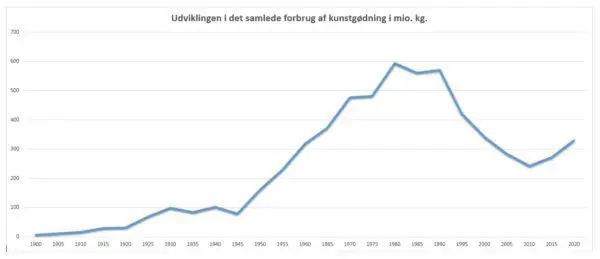
Figure – Development in total consumption of chemical fertilizer in million kg.
In Denmark, we imported fertilizers such as calcium nitrate from Germany and especially from Norway under the name “Norgesalpeter”. With the new fertilizers also came new tools and machines. However, up until the Second World War, many farmers were content to spread the fertilizers on the field from a cart using small shovels made for this very purpose.
From the beginning of the 1920s, several experiments were made with mechanical fertilizer spreaders, which showed that they were far more effective than spreading with a shovel. However, many of the first fertilizer spreaders, such as the so-called chain spreaders, were both expensive and required a lot of maintenance. The fertilizer often clumped together and the chain and bottom of the machine had to be cleaned. Therefore, the use of the spreading shovel continued for some time.
Villemoes spreader
In the 1930s, new, better, lighter and cheaper fertilizer spreaders began to gain traction among Danish farmers. In our collection we have one of the spreaders that was popular among Danish farmers for a long time, namely the so-called Villemoes.
Unlike other types of spreaders, which used chains or rollers to spread the fertilizer, Villemoes was a so-called disc spreader. It worked in such a way that the discs led the fertilizer out of the fertilizer container through openings in the rear wall, after which the fertilizer was distributed over the discs by means of a rotating shaft.

What appears to be Urea is being poured into the fertilizer container of a Vilmo spreader. Urea is a chemical fertilizer with a high nitrogen content. The picture is probably from the 1970s. Photo: Bror Bernild.
The model we have in the museum's collection is from the 1950s and is an improved version of the earlier Villemoes spreader from around 1929. It is a model 565 with 10 discs and a working width of 3.8 meters. In contrast to the earlier horse-drawn models, this model could be towed by a tractor, which was an advantage since around 511% of all agricultural properties had a tractor in 1960, and since part of the spreading of the fertilizer was also carried out by machine contractors.
The disc and spreading axles respectively worked independently of each other and were divided in the middle so that they were pulled by chain from each driving wheel. The fertilizer hopper was located in front of the driving wheels and the spreading therefore took place forwards towards the tractor, which had the advantage that the driver could keep an eye on any blockages in the machine. Another advantage was that a platform was located behind the fertilizer box for taking along extra fertilizer bags. Furthermore, the spreader could be set up for transport by removing one of the wheels and turning the spreading device with box lengthwise.
The Villemoes fertilizer spreader was originally developed by Diderik Villemoes and manufactured at Villemoesgård Maskinfabrik. However, from around 1930, Skive Jernstøberi og Maskinfabrik (later A/S Gyro) took over the manufacture of the fertilizer spreader, which was later marketed under the name Vilmo.
During the 1960s, the Vilmo spreader was gradually outcompeted by new types of spreaders, where the tractor's PTO shaft could be used to spread the fertilizer with centrifugal force. The new centrifugal spreaders were cheaper and more efficient. In addition, liquid ammonia was also used as a nitrogen-containing fertilizer, which created a need for a completely new type of fertilizer spreader.
A new type of work
The new fertilizer was different and had to be spread in different ways than livestock manure, which had been the most important traditional fertilizer. Therefore, fertilizer also brought new types of work and new tools and machines. Farmers also had to acquire new knowledge in order to be able to handle and spread the right composition of fertilizer in the right amounts.
In a report from the State Tools Committee in 1929, for example, it states that "spreading fertilizer is a quality job that must be carried out with care. Young people must be trained to carry out the spreading work with care. Supervisors must try to arouse interest in the work and understanding of its correct execution. The man who drives the fertilizer spreader must know what he is spreading, how much must be spread per unit of area - square meter of land or per hectare. He must know the length of the field and how much must be spread per turn."
Increasing attention to the environment and climate
During the 1970s, people began to become more aware of the negative effects of the increasing consumption of chemical fertilizers. The many nutrients in chemical fertilizers, especially nitrogen, that are spread on the fields also risk leaking into the surrounding environment. Therefore, the use of chemical fertilizers began to be gradually regulated, and the first aquatic environment plan was adopted by the Danish Parliament in 1987.
The increasing use of chemical fertilizers has allowed farms and fields to become larger, more uniform and more intensively cultivated. This can have consequences for biodiversity and has therefore also led to renewed focus on alternating between different types of crops and setting aside fields.
Finally, climate has entered the debate about fertilizer. The annual production and consumption of nitrogen-containing fertilizers worldwide contributes to over 2% of global greenhouse gas emissions, and fertilizers account for a significant portion of agriculture's total greenhouse gas emissions.
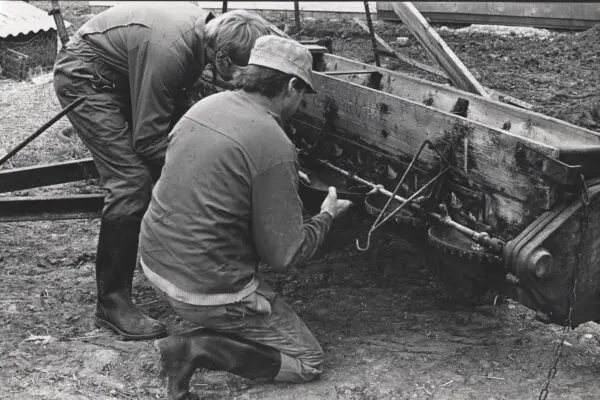
Two men in work clothes are preparing a Vilmo fertilizer spreader. Photo: Bror Bernild
As a result of political regulation and the more efficient use of chemical fertilizers on farms, the consumption of chemical fertilizers in Denmark decreased from the late 1980s to sometime in the 2000s. However, in recent years, consumption has increased again and, together with manure, constitutes important topics in current debates about nutrients in the aquatic environment and climate change.
At one time, artificial fertilizers were considered an unproblematic solution to the fertilizer problem, enabling agriculture to produce enough food for an ever-increasing world population. New machines and tools were developed and farmers had to acquire completely new types of knowledge about the new chemical and industrially produced agents. However, the increasing attention to environmental and climate problems has presented the development of technology, machines and knowledge within the production and use of artificial fertilizers with new challenges. Finally, the organic movement, where artificial fertilizers are not used, has experienced some progress in recent years in Denmark.
